Conventional wisdom dictates that larger wind farms are more efficient and effective, but as wind power becomes a more significant component of the world’s energy mix, building increasingly vast turbines could become prohibitively expensive. Halo Energy has developed a shrouded wind turbine that brings efficient energy production to small-scale turbines, which could improve the performance of US wind and address imbalances in the sector. JP Casey found out more.
Renewable energy is accounting for an increasing amount of the global energy mix, and wind power is leading the way. EU statistical office Eurostat reported in 2017 that wind power contributed 30.7% of the EU’s gross energy consumption, more than any other renewable source, and global installed wind capacity has climbed from 435,284MW in 2015 to 596,556MW in 2018, an increase of 28%.
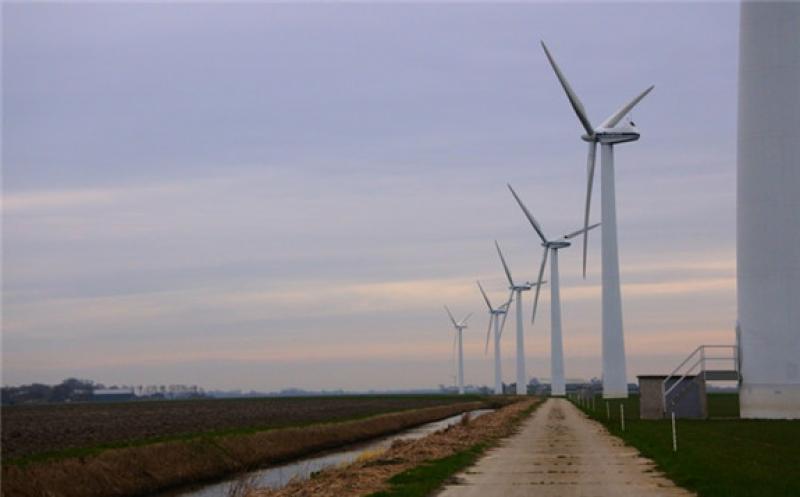
Much of this productivity has been achieved through utility-scale turbines, those producing more than 100KW, and which are typically collected in large farms. A guiding principle behind the growth of wind power is that taller turbines with larger blades are more efficient, producing more energy for the cost, which has encouraged manufacturers to produce increasingly vast turbines; for example Lockheed Martin has designed a gargantuan 50MW turbine, the blades of which are 200 metres long alone.
However, building increasingly large turbines requires greater investment of both money and resources, and intensifies the problem that turbines can only be productive in windy areas by making some turbines simply too large to operate in parts of the world.
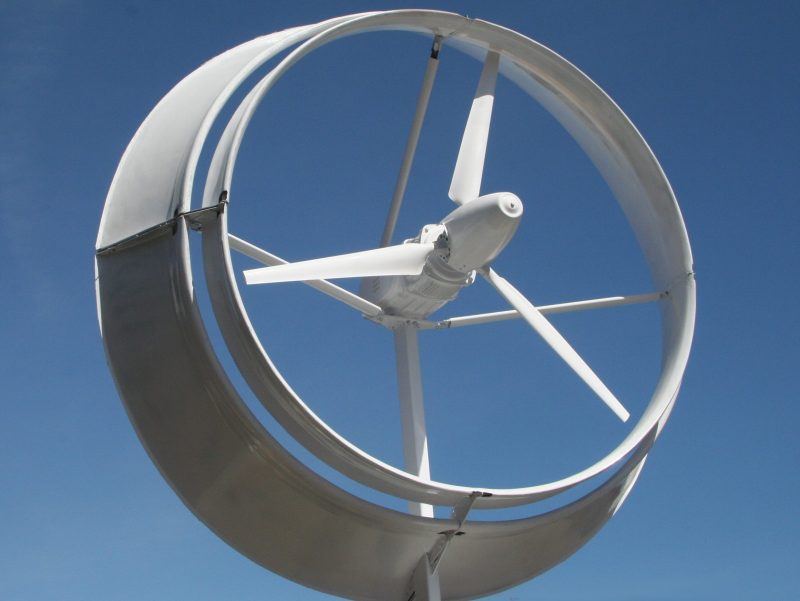
Distributed wind has emerged as a solution to this issue. Defined as a wind turbine producing less than 100KW, these smaller turbines can be deployed in a greater range of locations, and can involve individual people directly in the production of clean energy. One of the leading proponents of the ideas is US-based Halo Energy, which has developed a 6KW shrouded turbine. It measures just 12 feet in diameter, and could help address the wind sector’s imbalance between utility-scale and distributed operations.
A shrouded, more efficient turbine
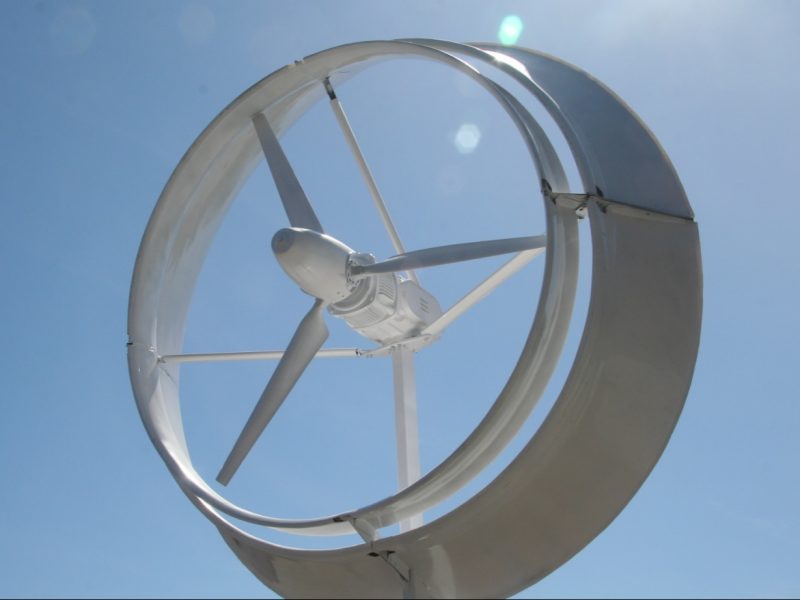
Halo’s turbine maximises its efficiency despite its limited size because of the static shrouds built around the three rotating blades, which create a fixed perimeter around the edge of the rotor sweep area, the space where the blades turn, effectively increasing the wind speed of air pulled through the blades.
“Jets of air that go through the rotor sweep area and between and around the two static shrouds come together downwind of the turbine, creating a lower pressure, which allows more air to rush in through the rotor sweep area from upwind of the turbine,” said Halo head of business development Charlie Karustis. “If the turbine is seeing a five metre per second (m/s) ambient wind, what’s really happening is that the blades are seeing a wind speed of around 10-12m/s.”
The result is a turbine that can produce twice the power of non-shrouded turbines of the same size, and is roughly half the size of conventional turbines of the same power capacity.
The static shrouds also help to overcome a key limitation of smaller-scale turbines, that of blade-tip losses. This is air deflected by the blades outside the rotor sweep area and not converted into electricity; while this is less of an issue in utility-scale turbines due to the larger quantities of power produced, if a distributed turbine has a maximum production of just 6KW, as does Halo’s turbine, these losses can be significant.
“When you take that conventional three-bladed technology and you shrink it down to a micro scale, those blade-tip losses become much more pronounced, and so the turbine becomes much more inefficient,” said Karustis. “This is the reason why we believe that micro wind, or distributed wind, has not proliferated like solar has in the last ten to 15 years.”
Karustis drew several comparisons between the development of wind and solar power in the US; while technological limitations prevented the former from spreading on a small scale, the fact that individual solar panels are cheap to purchase and easy to install has led to a dramatic increase in decentralised solar power. Wood Mackenzie reported in May this year that there were more than two million solar installations in the US, just three years after reaching the one million mark, a total which took 40 years to achieve. The research group expects the number of installations to reach four million by 2023, and Halo is optimistic that its shrouded turbine could usher in a similar change in the wind market.
Technological challenges and financial potential
Karustis talked about the difficulties of developing the project, with the technological obstacles among the most challenging to overcome.
“It took a lot of very specialised and smart engineers working on this because the interaction comes between the blades and the shrouds,” said Karustis. “It’s a very complex and intricate engineering process, so that took time to solve.”
Halo’s work was aided by the considerable expertise of its team – Karustis alone has worked in the wind industry for close to two decades – and the financial support of an older company, Ogin, a clean tech project funded by Kleiner Perkins. Both Karustis and Halo CEO Vin Loccisano worked with Ogin, where they developed a much larger shrouded turbine prototype, but the project was eventually abandoned due to spiralling costs. Loccisano and the rest of what would become Halo’s senior leadership then purchased the rights to the Ogin technology and repurposed it for smaller turbines, leading to the development of Halo Energy.
The company has invested more than $200m in research and development, which has helped fund the production of the turbines, and enabled Halo to complete testing on its first commercial turbine. The company plans to sell its first ten units by August, to a range of customers from individuals looking to place the turbines on their homes to commercial buildings. The company is aiming at the telecoms industry as its initial target market, but hopes to sell its product to customers in a range of sectors beyond.
“Now that we have the technology perfected, I think we’re seeing what we’re going to see, and what we’re going to see is a lot of interest in this turbine, and hopefully that will pay off all that hard work,” said Karustis. “We can make a profit on day one with our first turbine.
“It’s like any other product; if there’s high interest for the product, the money will follow.”
Playing catch-up in the US
“In Europe, offshore wind has been there for a number of years, but I think in the United States we’re a little bit behind that,” said Karustis.
Should it be successful, Halo’s approach could lead to a surge in US onshore wind, which has historically lagged behind other regions in terms of wind installation and production. Since 2016, according to the International Energy Agency, the US has installed just 22.6GW of new onshore wind capacity, compared to 30.7GW in the EU, and 50.3GW in China, struggles that Karustis hopes to address.
Last December, the Chinese Government approved a number of new offshore wind projects, totalling 13GW of production and costing around $13.3bn, as the country continues to invest in utility-scale power. Karustis hopes projects like Halo’s distributed turbine can contribute to a more balanced wind sector in the US, with both large- and small-scale operations expanding renewable power.
“The large-scale wind turbines wouldn’t be phased out, it’s kind of an ‘all of the above’ thing,” he said. “The large wind farms play a very important role for us in reducing the carbon footprint globally, and hopefully the micro wind market is going to augment that by producing energy where energy is being used. It’s a good two-pronged approach.”
This two-pronged approach also includes other renewable power sources, including solar and utility-scale wind; Halo is not trying to replace all clean energy with its turbines, but offer another option for people eager to engage in renewable power, who may have been historically sidelined due to the high costs of building utility-scale facilities or the unsuitable geographical characteristics of the places they live.
“When you look at that market we’re very excited because just as megawatt-scale wind is a large market, I think distributed wind can be as big of a market or bigger over time,” said Karustis.
“When you have incentives and improvements in the technology, the costs go down, so you can be more competitive and compete, and that’s certainly the case with megawatt-scale wind,” he continued. “Just 15/20 years ago, it wasn’t competitive with natural gas [and] coal, but it is now. So those government policies have helped and they’ve driven the technology improvements, so it’s all bundled together.”