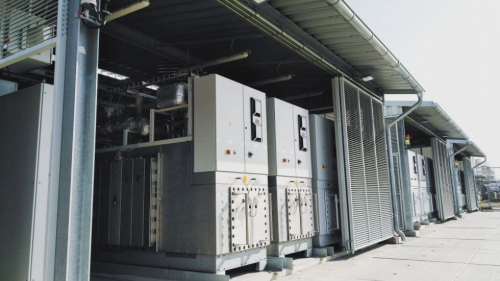
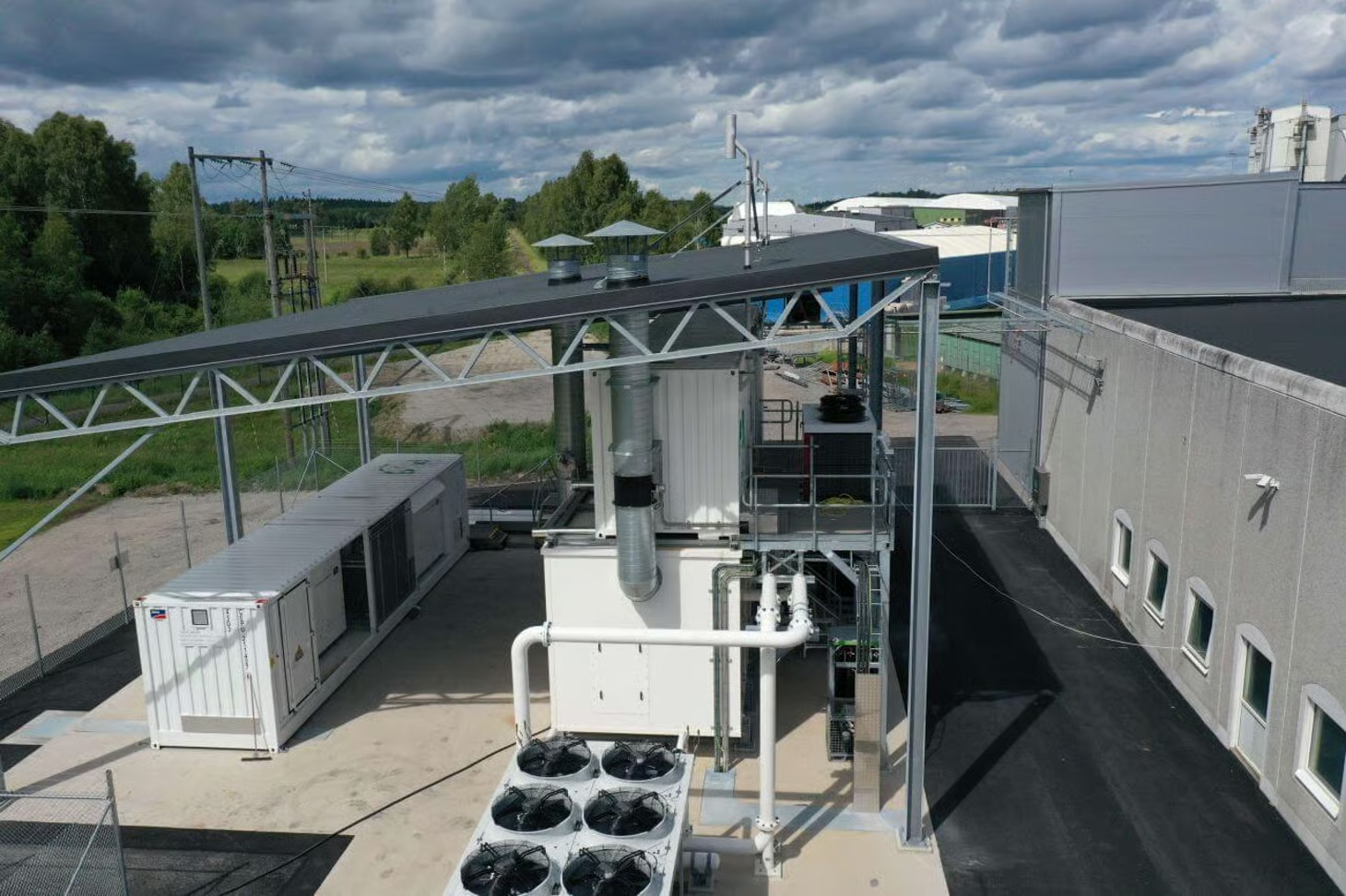
Bloom?Energy ?has unveiled the previously announced ?Bloom Electrolyzer.
The electrolyzer will be built at the company’s Newark site.
The system ?uses the technology employed in the company’s electricity-producing fuel cells and can be fueled by multiple sources, including renewable energy and excess heat.
Bloom says that because the equipment operates at high temperatures, it requires less electricity to break up water molecules and produce hydrogen.
The elecrolyzer can use both electricity and heat to produce hydrogen and can reduce electricity use by as much as 45%.
“The launch of the Bloom?Electrolyzer?is a big leap forward?in our mission to?enable and empower?the global hydrogen economy and a decarbonized society,”?said?KR Sridhar, CEO,?Bloom Energy.?“Hydrogen enables us to leverage abundant and inexpensive renewable energy to provide zero-carbon power,?reliably—instead of intermittently.?Given?its efficiency and input options to make hydrogen,?Bloom Energy’s?electrolyzer?is expected to produce?hydrogen at?a?lower?price than any alternative on the market?today.”??
High-temperature electrolysis? unlocks substantial value?with?heat-intensive?processing applications?in hard-to-decarbonize?heavy industries,?like?steel, chemical, cement, and glass manufacturing.
By? utilizing? excess?heat from these processes, hydrogen can be produced at a higher?electrical?efficiency.? Also, ?the?hydrogen?required to power high-temperature furnaces at these factories can be produced on-site using Bloom?Energy?electrolyzers,?eliminating transportation and distribution costs.
When the Bloom?Electrolyzer?is paired with intermittent renewable resources, such as wind and solar, the resulting green hydrogen provides an important storage mechanism.?Hydrogen can be stored for long periods of time and transported over long distances. Alternatively, Bloom Energy’s fuel cells can convert this hydrogen to electricity, thereby providing continuous, reliable power.
Bloom Energy ?began ?manufacturing ?in the U.S.?in 2001 and now supports ?more than 1,500?American clean energy?jobs.?Bloom?Energy’s Sunnyvale,?California ?, and Newark, Delaware ?manufacturing facilities?can produce? 500? megawatts? of?electrolyzer s?today and? a? gigawatt ?within a year.
The Bloom?Electrolyzer?utilizes?the same solid oxide platform?as the?company’s?core?fuel cell?product. Those features could allow scaling up of hydrogen systems, the company noted.
Bloom Energy’s?technology?dates to?the?1980s?when?the?co-founders first?developed ?electrolyzers?to support ?the ?military and ?later? NASA’s? Mars?exploration programs.?In the? early? 2000s, 19 patents?were?awarded to Bloom?Energy for its?electrolyzer?technology.
The Biden-Harris administration has been pushing alternate energy sources as a way to shift from fossil fuels. South Korea is focusing on hydrogen with Bloom partnering on a project.
Additioanlly a national laboratory will study whether Bloom electrolyzers can be used as a way for nuclear power plants to produce hydrogen at times when electricity demand is lower and plants would otherwise have to power down.