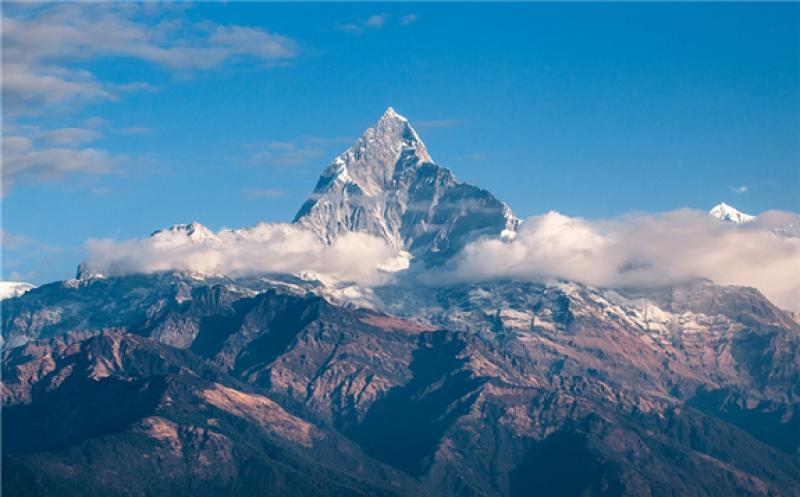
The Kingdom of Bhutan is a small, mountainous, landlocked country in South Asia, located in the eastern Himalayas, bordered by India and China. Bhutan is home to a population of about 757,000 spread over approximately 38,394 square kilometers, roughly the size of Switzerland, with about 70.5 percent of its land under forest cover. Much of the population lives in the central highlands, and almost two-thirds are classified as rural inhabitants. The terrain is mostly mountainous, with alpine peaks in the north and some sub-tropical foothills in the south. Gross National Income (GNI) per capita has consistently risen from US$730 in 2000 to US$2,409 in 2014, which is one of the highest in South Asia.
Politics
Bhutan has seen significant political changes in recent years. In 2008, the country undertook a transition from an absolute monarchy into a constitutional monarchy with an elected parliament, following a decade of planning and public consultations. After 34 years on the throne, the Fourth King, His Majesty Jigme Singye Wangchuck, stepped down on December 9, 2006, in favor of his son, His Majesty Jigme Khesar Namgyel Wangchuck. A constitution was prepared, involving widespread public consultations within Bhutan and with the international community. The new democratic system comprises a National Council and a National Assembly, the latter based on political party affiliations. The first elections for the National Council were held on December 31, 2007, while elections for the National Assembly were held on March 24, 2008. The second Parliament elections were held in 2013 where the People’s Democratic Party (PDP), the former opposition party gained the majority by winning 32 seats and formed a government under Prime Minister Tshering Tobgay. In its election pledges, the PDP outlined its vision for the country of greater decentralization, civil service efficiency, incentives for green industries, and balanced regional development with meaningful engagement of the private sector and foreign investment in the economy.
Economy
Bhutan’s economy has expanded at a robust pace driven by the hydropower sector. Gross Domestic Product (GDP) growth is estimated at 6.5 percent in FY2014/15 (from July 2014 to June 2015). Drivers of growth include continued construction of hydropower dams, the five-year plan implementation in full swing through increased capital spending financed by grants and tourism. On the demand side, while private consumption was supported by the relaxation of credit restrictions, investments have remained robust in hydropower and construction in particular. Growth of gross capital fixed investment is estimated at 10 percent, masking a larger expansion in the hydropower sector. Real export earnings grew at 3.3 percent, supported by tourism expansion, but was outpaced by rapid import growth (11.5 percent).
The poverty rate at the international line of US$1.90 a day (2011 Purchasing Power Parity Index) was 2.2 percent in 2012, one of the lowest in South Asia. At a higher poverty line of US$3.1/day, poverty decreased from 29.1 percent to 13.4 percent between 2007 and 2012 or 3.1 percentage points per year. During the same period, the mean per capita expenditure grew at 6.5 percent overall and also for the bottom 40 percent, according to the 2007 and 2012 Bhutan Living Standard Surveys. Bhutan’s growth rate for the bottom 40 percent was the highest among the six South Asian countries for which data are available circa 2007 and 2012.
The fiscal deficit in FY2014/15 was 2.5 percent of GDP. Civil service wages and allowances were increased by 19 to 23 percent respectively but the impact on spending was partly offset by a stabilization of non-wage current and capital expenditures in real terms. Domestic revenues as a share of GDP have declined over the last three years, from 22 percent to an estimate of 19.9 percent in FY2014/15, while grants finance 27 percent of the budget, 70 percent of which come from India. Bhutan’s public and publicly guaranteed external debt stood at 99 percent of GDP by end-June 2015, two thirds of which are from commercially profitable hydro projects. Domestic debt stood below 5 percent of GDP. The latest Debt Sustainability Analysis (DSA) jointly conducted by the World Bank and IMF in June 2016 confirmed that Bhutan’s debt dynamics are subject to a moderate risk of distress.
Bhutan runs a growing current account deficit (26 percent of GDP in FY2014/15), to which the hydropower sector contributed 15 percentage points. The deficit is essentially financed by donor resources, to which India contributes the most through loans and grants financing hydropower projects. International reserves had slightly declined to US$ 958 million by June 2015, while remaining at a very comfortable level of about 10 months of imports, reflecting prudent management.
Inflation rate measured by the consumer price index has slowed to 3.3 percent in May 2016 from 3.4 percent in July 2015, driven by the decline in oil prices and India’s easing of inflation (Bhutan has a fixed exchange rate with India from which it imports most of its consumption).
Development Challenges
Overall, Bhutan’s development has been rapid. Until the 1950s, Bhutan was largely isolated from the rest of the world, and its dispersed rural population depended on subsistence agriculture. Once it started a gradual process of opening up to the outside world in the 1960s, the country embarked on a far-reaching development strategy that has been articulated in a series of five-year development plans. The Eleventh Five-Year Plan (2013-2018) (11th FYP) is currently under implementation. The overall goal of the 11th FYP is “Self-Reliance and Inclusive Green Socio-Economic development”. The Guidelines for the Preparation of the 11th FYP states that although economic growth is a necessary condition for development, economic growth by itself does not necessarily translate into effective poverty reduction and broad based improvement in people’s quality of life. The Gross National Happiness (GNH) is a vision expressed by Bhutanese leaders, which supports the pursuit of higher collective wellbeing in all its dimensions, economic and non-economic, monetary and non-monetary as opposed to GDP or profit maximization. GNH is translated into broad policy directions which overarch Government long-term strategies and five-year plans. The four pillars of GNH philosophy are: sustainable development; preservation and promotion of cultural values (traditional and cultural heritage paramount - its loss leads to a general weakening of society); conservation of the natural environment (Bhutan’s constitution: 60 percent forest coverage, green economy), establishment of good governance. Therefore, Economic Development and Social Development (GNH – Pillar 1) shall be the two key thrust areas for the Eleventh Plan, with Balanced Regional Development complementing the efforts under Economic Development and Social Development. Carbon Neutral/Green Development (Pillar 2), Strengthening the Bhutanese Identity and Culture (Pillar 3) and Strengthening Good Governance (Pillar 4) shall be pursued under cross-cutting theme.
The overall outlook is positive but macroeconomic pressures on domestic demand must be managed. The impact of the ongoing turbulence in global financial and exchange markets is expected to remain moderate on Bhutan’s economy, mostly through higher imported inflation and lesser tourism earning in the event of a global economic slowdown. While debt risk is assessed as moderate, the rapid build-up over the recent year cautions against any additional non-concessional borrowing, given that Bhutan’s debt-carrying capacity will only improve in the long run reflecting significantly higher electricity exports when hydropower projects come on stream. Efforts to deepen the financial sector must be sustained to provide the country the basis for financing sound and sustainable development and diversification.
Despite remarkable progress in poverty reduction, large urban/rural gaps remain. In 2012, rural poverty rate stood at 19 percent, compared to less than 2 percent in urban areas. Over 90 percent of the poor (at PPP US$3.1/day) lived in rural areas. While poverty incidence is low, urban areas face a higher unemployment rate (6.7 percent) than rural areas (1.2 percent). The gap is more pronounced for youth unemployment: 28 percent in urban and 4.8 percent in rural in 2015. Queuing for public-sector jobs and high reservation wages among urban youth and widespread informality in rural areas point to significant mismatches in the labor market.