For many years, the World Economic Forum (WEF) has been at the forefront of discussions on climate change and the Fourth Industrial Revolution.
The Fourth Industrial Revolution is well and truly upon us. This technological revolution is fundamentally altering the way that we live and interact with each other. Change is occurring at a dizzying pace, including the type of energy we use and how we consume it.
This rapid change is occurring at a time when the energy transition to net-zero has stagnated, despite renewables being in the early innings of exponential growth (Figure 1). If we are to stave off the worst of climate change, we must reach net-zero emissions by 2050. However, not enough progress has been made, with 81% of the global energy system still based on fossil fuels, the same percentage as 30 years ago.
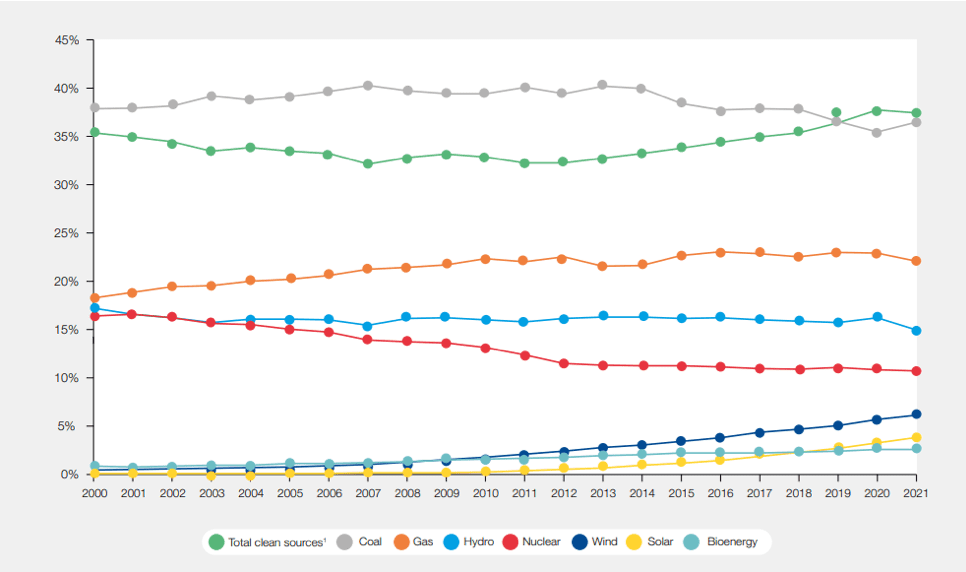
1. Graph showing the growth of clean energy since the year 2000. Source: World Economic Forum
The energy industry must harness the power of the Fourth Industrial Revolution to overcome what’s known as the energy trilemma: the transition to net-zero, energy security, and energy affordability.
Digital Is Driving the Transition to Net-Zero
This year’s WEF annual meeting at Davos focused extensively on digital technology’s crucial role in driving us to net-zero. Many business leaders have made the point: Christain Klien, CEO of SAP Software Solutions, said that “technology is make or break to achieve net-zero,” and according to Karen Karniol-Tambour of Bridgewater Associates, “Digitalization is one of the most under-appreciated levers in the energy transition.”
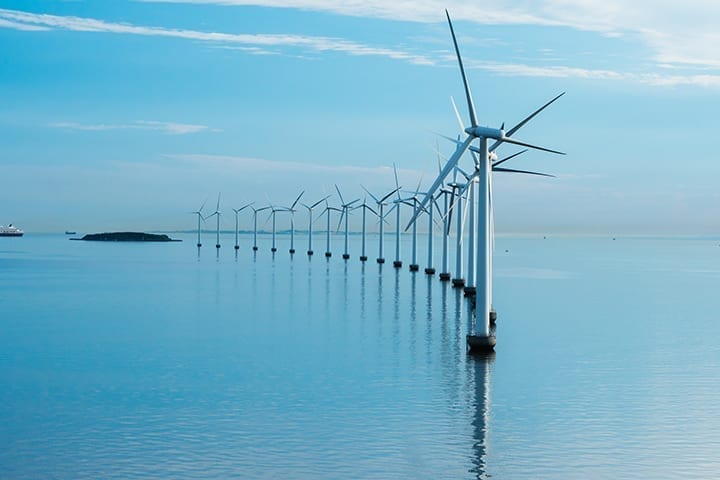
Globally, if we are to transition to net-zero by 2050, we need to massively increase renewable energy capacity. The International Energy Agency (IEA) estimates that the rate at which renewable energy capacity is added must increase from 134 GW a year in 2020 to 630 GW a year in 2030. In offshore wind, for example, 95% of the capacity required to hit the 2050 net-zero target is yet to be built.
Digital twin technology is a great example of how technology can help accelerate required power generation progress by creating a powerful innovation curve in the offshore wind industry. Predictive digital twins of offshore wind turbines allow for the development of leaner, more efficient, and innovative designs. The digital feedback loop provided by this technology allows for improvements to both the design and operations of wind turbines, which in turn lead to lower costs, shorter timeframes to design and build wind capacity, and therefore increased renewable energy adoption. That’s the type of powerful virtual circle we need to search for to address the challenge systematically.
Collaborate and Share Data to Reach Net-Zero
Another way that Fourth Industrial Revolution technology will help complete the transition to net-zero is by working together to collaborate and share data. As José Ignacio Sánchez Galán, CEO of Iberdrola, pointed out in Davos, “It’s not a question of one against another, it’s a question of one beside another.”
And let’s remember that partnerships require determined and constant effort. As a board member of one of the largest European companies pointed out in a private session, “our company is over 100 years old, and we pretty much invented ‘Not Invented Here.’ Introspection is a strength!”
Let’s look again at the offshore wind industry. We see that original equipment manufacturers (OEMs) are reluctant to share data because of a misconstrued association between data sharing and intellectual property risks. In the Davos session on hyper-connected manufacturing, it was discussed how “we need to build capability to exchange trustworthy data relevant to our customer value.” Such data sharing allows innovation-hungry players to develop pioneering solutions, moving us closer to net-zero.
Diversification and Energy Security
“We are in the middle of the first global energy crisis. In the 70s, it was the oil crisis. Now, we have an oil crisis, a natural gas crisis, a coal crisis, with oil prices skyrocketing. Energy security is a priority for all governments,” Fatih Birol, executive director of the IEA, WEF Session “Energy Outlook: Overcoming the Crisis,” May 23, 2022.
The IEA describes energy security as the “uninterrupted availability of energy sources at an affordable price.” Energy security, then, inevitably means not relying too much on one single energy source and producing as much energy locally as possible. With this in mind, Fourth Industrial Revolution technologies help achieve energy security in two ways. The first is by supporting diversification of the energy mix while also helping maintain and care for existing assets. The second is by preventing large-scale capacity downtime, as we have seen in French nuclear power plants over the past year.
Increasing the capacity of sources, such as offshore wind, also improves energy security as it diversifies the energy mix. The challenge is still bringing costs down and coupling them with energy storage.
Currently, the cost of solar energy is much lower than that of wind. Solar Levelized Cost of Energy (LCoE) has decreased about four times faster than offshore wind in the last decade. Digital simulation technology can bring the price of offshore wind down by creating more efficient designs. This is critical as it allows offshore wind and solar to complement each other on the power grid.
Finally, there is no secure, diverse energy without the ability to store renewable energy effectively. Fortunately, numerous energy storage companies are working hard to create storage solutions to meet demand, including liquid air energy storage, compressed air energy storage, and pumped hydro storage solutions. Generation cost is again a vital part of the equation—one energy company estimates we need LCoE of offshore wind at $30/MWh to be economically coupled with hydrogen.
Maintaining Critical Assets
Another way Fourth Industrial Revolution technologies are improving energy security is by maintaining and extending the life of critical energy assets. While it is imperative to move to net-zero as soon as possible, it is undeniable that we will need fossil fuels for a good few years to come while we transition. In this case, the challenge is to continue using oil and gas without building more infrastructure that would lock in emissions for years to come and kill the clean energy transition. We need to make the most of the existing oil and gas infrastructure to avoid this.
In this area, digital simulation organizations can perform real-time health monitoring of energy assets to reduce risk and critical failures. The software offers high-resolution, targeted monitoring to warn of issues before they arise, and show how much life remains before replacement or repair is required. Our structural digital twins can inform maintenance teams of safety-critical areas down to the nearest centimeter or even millimeter. This immediate identification of issues prevents problems from worsening and significantly extends the lifespan of assets.
Energy Accessibility and Affordability
The Fourth Industrial Revolution has the potential to improve the lives of millions of people globally by increasing access to electricity. In 2019, there were 759 million people globally without access to electricity, mainly in the developing world. The falling price of renewable energy is changing this, as many of the areas with the lowest access to electricity have favorable conditions for renewable energy deployment. Sub-saharan Africa, for example, has exceptional potential for solar power, which is rapidly falling in price and becoming easier to deploy. Officials from the region mentioned projects generating $10/MWh, which is incredibly affordable.
In the developed world, the issue of energy affordability is being tackled by technology, such as the digital twin technology discussed above, helping reduce the cost of renewable energy technologies such as offshore wind by improving designs. In addition, Fourth Industrial Revolution technologies can help save homeowners energy by optimizing energy consumption through behavioral interventions. An excellent example of this is smart thermostats, which can save 10%–12% on heating and 15% on cooling bills.
A Revolution for the Better
“The best hope that we have is that everything can happen faster and cheaper than we ever thought before … our estimations were wrong. We were faster and cheaper with renewables than we ever thought, and if we continue this path, we have a fine idea of the future,” Robert Habeck, vice-chancellor of Germany, WEF Session “Energy Outlook: Overcoming the Crisis,” May 23, 2022.
The Fourth Industrial Revolution is intertwined with the energy transition and both are happening at breathtaking speed. The digital technology we are developing can help scale renewable energy at the pace required to meet net-zero targets, while ensuring energy security, and improving access to energy and electricity costs for millions of people.
The transition is occurring rapidly, and many people will understandably feel anxious and disorientated by the rate of change. However, we are moving to a better, cleaner, more secure place for all.