Hydrogen is seen by many as an effective solution to decarbonise polluting sectors. Many countries have made this energy vector a central element of their energy transition strategy with a view to drastically reduce industrial emissions, storing electricity and propelling the mobility of tomorrow. Renewable hydrogen breaks the codes as it can be produced almost anywhere thus changing the energy geopolitics. European countries want to take part in this green revolution and have announced major investments, such as France with €7B by 2030. The race to master this industry will include Japan, China, South Korea, and the United States who also want to impose their leadership.
In this article, we lay the foundations of what could be the future geopolitics and geoeconomics of hydrogen. As the whole world is thinking about hydrogen, we will try to understand how the hydrogen economy could be and which countries may dominate the market. Finally, we will identify new geostrategic dependencies that could emerge for the European Union and how it intends to deal with them.
With hydrogen industry comes challenges
States' energy strategies and policies consider supply security, costs and, more recently, environmental impact, in particular climate impact. With a need to phase out from fossil fuels, hydrogen is seen as a solution to decarbonise energy systems and establish energy independence from some countries.
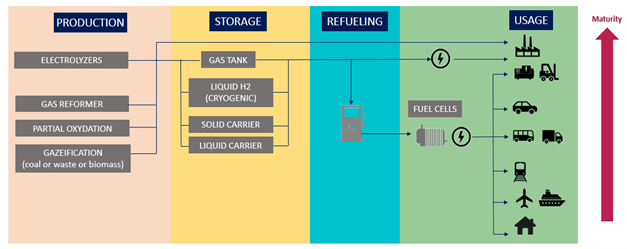
Developing a renewable hydrogen economy and making an economically attractive alternative give rise to two challenges: creating the demand and ensuring the supply. It is on one side based on the uses’ development (industry, mobility…) to replace fossil fuel consumption, and on the other side, the hydrogen supplied must be low-carbon or renewable.
Globally, 90 Mt of hydrogen are produced annually and mainly from fossil sources and associated emissions. The share of decarbonated hydrogen, i.e., the production of which does not emit CO2, is still embryonic (less than 1% in 2020). This proportion shall increase within the coming years as there are several hundred electrolysis projects under development. Despite this encouraging momentum, if all projects are completed, their output would only represent about 5% (5 Mt) of hydrogen annually consumed in 2030. Another way to decrease the carbon content of the hydrogen produced is to capture and store carbon emitted during production processes. This low-carbon hydrogen could represent 10% (9 Mt) of the global production. Renewable hydrogen made from electrolysis is seen as a major mean of producing tomorrow’s hydrogen. Projects will have to deal with the resources’ availability, both renewable (solar, wind…) for electricity supply, and water, consumed at 9 kg to produce 1 kg of hydrogen.
Once hydrogen is produced in a renewable or low-carbon way, uses can be decarbonised. Both current and future usages will, for sure, increase the hydrogen demand. For now, refining and chemistry industries are highest hydrogen consumption sectors. Tomorrow's carbon neutrality implies the development of new uses for hydrogen: electricity production for mobility and stationary usage, natural gas pipelines injection (and so, heating), synthetic fuel production etc. Hydrogen will be relevant in sectors where emissions are hard to abate but not that easy to implement. Let’s not paint it all “pink and shiny” …
For uses, we should start with industry, which is a top priority in terms of potential use (e.g., amounts of hydrogen) and as a high emission sector to be decarbonised. The industry transition to renewable hydrogen use is likely to be lengthy as it involves the transformation and adaptation of infrastructure (e.g., furnaces, turbines) involving substantial investment. For now, demonstration projects are announced as, for example, a decarbonised hydrogen steel plant in Sweden.
Secondly, the transportation sector accounts for more than 20% of GEG emissions and relies on petroleum products at 90%. Despite the hype, still a very tiny proportion of vehicles are powered by hydrogen. Focus is on Heavy transportation, starting with road transport (trucks & buses) but shipping and aviation sector transition shall take more time. It will probably require the use of liquid hydrogen or hydrogen derivates, that rely on a higher energy density than gaseous hydrogen. However, adoption in light road transport is still questionable as hydrogen faces competition from batteries.
Thirdly, hydrogen represents an interesting alternative to batteries for storing surplus electricity from intermittent energy sources on short or long period. It can also be injected into natural gas pipelines to fuel domestic boilers.
Current and future hydrogen use
Zoom 1: what future for each type of mobility?
Despite enabling policies in South Korea, Japan, China or California, fuel-cell electric light vehicles have not caught on, unlike battery vehicles. Indeed, less than 50,000 hydrogen fuel-cell vehicles were circulating at mid-2021 against 11 million of battery-powered vehicles. These countries have the largest number of vehicles thanks to their leading policies and their automotive industry players offering hydrogen mobility. South Korea, which is the world's largest market for fuel-cell electric vehicles, benefited from a generous subsidy program on the Hyundai Nexo locally produced. Other Asian markets like China and Japan still want to enhance this mobility with targets of around 1 million vehicles on the road by 2035 (including bus and trucks). On the opposite, Europe accounts for a small share of fuel-cell electric vehicles (6%).
Despite the enthusiasm of Asian countries, light mobility seems struggling to gain a foothold, suffering from a lack of competitiveness and lower efficiency with battery technology.
Heavy mobility fuel by hydrogen vehicles will probably aspire to a better future as direct electrification (battery-powered vehicles) which may not be optimal considering the reduced autonomy conditioned by the battery capacity. Nonetheless, nothing is written considering the progress of battery technologies and the difficulty of deploying hydrogen charging infrastructures.
On the shipping side, particularly on large ocean-going vessels, hydrogen could be a relevant solution if used as intermediary to produce synthetic fuels. According to its low volumetric density, hydrogen-based fuels are preferred as they can be directly injected into combustion engines and benefit from existing infrastructures without major changes. Ammonia could endorse this role thanks to its higher volumetric density and its facilitated and costless logistics (including production, storage, and distribution). However, there are still some techno-economic obstacles to overcome, but several shipbuilders have announced their intention to market ships with 100% ammonia engines from 2023, and to offer ammonia retrofit solutions for existing ships from 2025. Moreover, some ports have initiated the integration of hydrogen bunkering infrastructures allowing the future use of hydrogen and ammonia.
Although the maritime sector is a behemoth to be decarbonised, ammonia could account for up to 45% of global shipping fuel demand by 2050.
Aeronautics is also a matter of interest for hydrogen integration. Tracks are being studied to design aircraft burning hydrogen in their engines and producing electricity thanks to the fuel-cell. Airbus is already handling the subject, but commercialisation is not expected before 2035. As for maritime sector, hydrogen could also be used to produced synthetic kerosene.
Finally, hydrogen in railway sector is seeking interest to replace diesel on non-electrified lines. Germany commissioned the first Alstom hydrogen train in 2018, followed by other countries such as France. This decarbonisation option should however remain marginal.
Hydrogen for mobility is thus a matter of interest according to its decarbonisation perspectives. Market will certainly remain embryonic in the short-term, but its adoption could accelerate after 2030 thanks to the increasing demand in both consuming sectors, such as shipping, and aeronautics.
Zoom 2: what status for hydrogen in electricity production and storage?
In terms of electricity generation, hydrogen can be used in a stationary fuel-cell or as ammonia or as a fuel in gas turbines. Some gas turbine manufacturers indicate that their systems can already accept 50% of hydrogen blended into natural gas. Even if this application still represents less than 0.2% of global electricity generation, this segment could represent in the long-term an important consumption source.
Fuel-cells are seen as a tool for grid flexibility, allowing electricity to be stored when there is a surplus and returned to the grid during periods of high-consumption. However, this option competes with other storage options including pumped-storage hydroelectricity, batteries, thermal-storage, etc. Batteries benefit from better round-trip efficiency than hydrogen are already deployed and are still fast developed. Batteries will probably be preferred for short-term matters: temporary storage and intra-day fluctuations management in electricity grid. In seasonal, long-term storage applications or large excess production (e.g., excess of PV production in summer to be stored for winter electricity peak demands), hydrogen could be the optimal solution to capitalise on its production during renewable electricity excess periods, to benefit from geological storage, and then, to convert it back when electricity supply is needed. If batteries are most interesting for short-term and cycling, hydrogen is more plausible for seasonal storage, especially as low-cost storage per megawatt-hour.
Stationary fuel-cells can also be used to back-up power supply in critical sectors such as hospitals and data centres, and to provide off-grid electricity. In 2020, there were 2 GW of stationary fuel-cells operating, mainly in Japan.
As a gas, hydrogen can also be directly injected into gas grids. It can be blended into existing natural gas networks (with a proportion from 5 to 20%) or pure in dedicated pipelines. Hydrogen in gas grids represents another electricity production decarbonisation track for gas-based power plants. Pilot projects are already in place in the Netherlands or in France. Partially injected into natural gas grids, it doesn’t need major infrastructure changes.
Even if hydrogen is addressing the electricity production and storage sector, the future of these applications remains uncertain. Few countries integrated this option into their strategic plans except pioneers such Japan, South Korea or Germany. Developments of these uses are likely to suffer from their low visibility. Hydrogen should, at best, only contribute to 1 or 2% of electricity production by 2050.