Solar cell technology used to manufacture photovoltaic (PV) modules is constantly evolving as new, more advanced and more efficient technologies are developed. Tunnel oxide passivated contact (TOPCon) solar cell technology is a new development with the potential to replace passivated emitter and rear contact (PERC) and high-efficiency passivated emitter, rear totally-diffused (PERT) solar panels.
TOPCon solar cells represent an upgraded and more efficient technology compared to PERC/PERT solar cells, featuring a highly similar structure.
In this article, we will explain important details on this technology, going from the basics, structure and manufacturing, comparison against other popular technologies in the solar industry, advantages and disadvantages, and more.
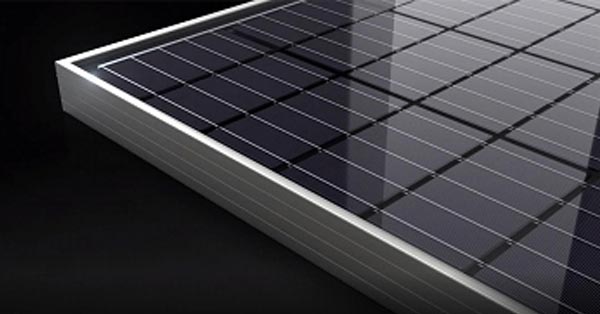
Tiger Neo bifacial TOPCon solar panel - Source: Jinko Solar
TOPCon solar cell technology: Understanding the basics
TOPCon solar cell technology is one of the latest trends in the solar industry, developed as an upgraded and more advanced version of the PERC/PERT technology. One of the main advantages of TOPCon solar cells is that the structure is only slightly different from PERC/PERT solar cells, meaning that manufacturers can use practically the same production line with a few improvements to produce TOPCon solar cells.
TOPCon solar cell technology was first introduced as a concept in 2014 by the Fraunhofer ISE German PV research institute. The project designed to develop this technology took place from 2013 to 2016, but it was not until 2019 that companies like Trina Solar scaled it to production. As TOPCon solar cell technology proved as a successful upgrade from PERC solar cells, many other companies including LONGi Solar, Suntech, Canadian Solar, and many others got interested in it.
The main setback of this new technology compared to PERC/PERT is that the TOPCon solar cells require a larger amount of silver (Ag) for production. This silver increase translates into a higher manufacturing price; however, new developments might prove successful in reducing the required amount of silver, while still delivering similar or even higher efficiencies and reducing production costs.
Structure and manufacturing of TOPCon solar cells
TOPCon solar cell technology features a similar structure and manufacturing process to PERC solar cells, featuring only a few additional steps. In this section, we explain how both of these work:
Structure of the TOPCon solar cell
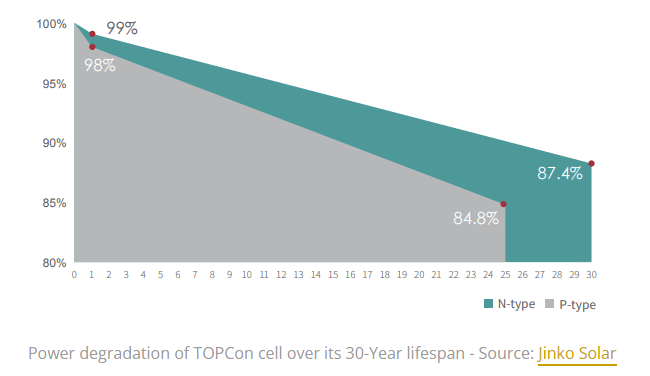
TOPCon solar cells can be manufactured as n-type or p-type solar cells, but the n-type variation has proven to be more efficient and resistant to impurities. Because TOPCon solar cells are an upgrade from PERC/PERT solar cells, it is important to understand the structure of this new technology.
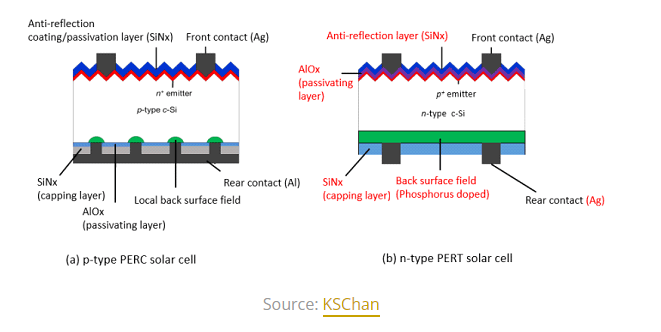
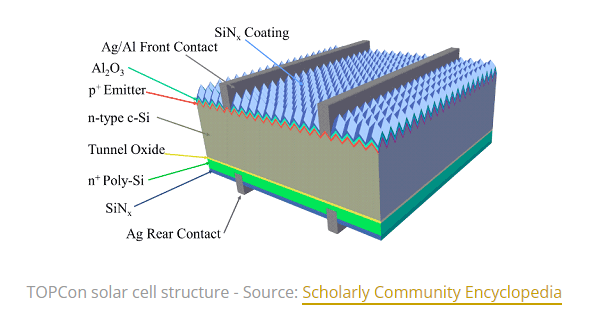
PERT solar cells are manufactured with an n-type crystalline silicon (c-Si) bulk layer because of its higher surface quality and it is coupled with a p+ emitter layer to create the p-n junction. The emitter layer is covered with an aluminum oxide (Al2O3) passivating layer and topped with a silicon nitride (SiNx) coating for its anti-reflecting properties. PERC solar cells replace the absorber layer with a p-type bulk layer and an n+ emitter for the p-n junction.
The lower part of the bulk region is doped with phosphorous to create the back surface field, and it is then coated with SiNx similar to the top of the cell. Both the top and bottom of the solar cell are equipped with silver (Ag) or aluminum (Al) contacts to close the circuit when the cell is being connected to the load or other cells at the time of manufacturing the PERC/PERT solar panel.
The PERC/PERT solar cell structure has proven to be quite efficient since it was introduced to the market and implemented to manufacture PV modules, but researchers found ways to improve it and therefore created the TOPCon solar cell.
The TOPCon solar cell structure takes the base structure of the PERT solar cell but includes an ultra-thin silicon dioxide (SiO2) layer working as the tunnel oxide layer and replaces the back surface field layer with phosphorous-doped polycrystalline silicon (n+ Poly-Si) layer. These modifications have improved the efficiency by reducing the recombination process thanks to the passivation in the added layers.
Manufacture of a TOPCon solar cell
One of the best things about TOPCon solar cell technology is that the manufacturing process is so similar to that of PERT solar cells that manufacturers will only have to make a little investment to upgrade their existing production line. Most of the manufacturing equipment can remain the same. This makes TOPCon solar cells an excellent investment for PERC/PERT PV module manufacturers already in the market.
After the TOPCon solar cells are manufactured, I-V solar cell curve characterizations are performed to evaluate their performance.
There are only a few additional steps required to manufacture a TOPCon solar cell instead of the PERT solar cell, making this new technology financially attractive for the solar industry.
How do TOPCon solar cells compare against the most popular PV technology in the market?
TOPCon solar cell technology is quite promising, having the potential to rapidly grow within the solar industry. When considering a new rising technology like this one, it is important to analyze it against other popular PV technologies in the market. In this case, we will compare TOPCon solar cell technology against PERC and heterojunction (HJT) solar cell technologies.
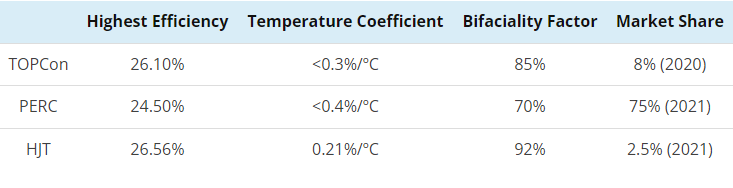
PERC solar cell technology currently sits in the first place, featuring the highest market share in the solar industry at 75%, while HJT solar cell technology started to become adopted in 2019, its market share was only 2.5% by 2021. TOPCon, which is barely present in the market, already represents 8% of the PV market, but it might start to grow in 2023 as major manufacturers switch from PERC/PERT to TOPCon.
Considering the technical specs, PERC technology is left behind by both HJT and TOPCon solar cell technologies. While PERC features a 24.5% efficiency and 70% bifaciality factor, TOPCon takes the efficiency to 26.1% and the bifaciality factor to 85%, while HJT goes even further with an efficiency of 26.56% and bifaciality factor of 92%. The temperature coefficient for PERC solar cells is worse when compared to TOPCon with its 0.3%/ºC, while HJT solar cells go even lower than that to 0.21%/ºC.
HJT solar cells might look quite promising, but there are major setbacks to this technology because of the higher production cost for solar cells and the incompatible production line with current technologies. This is where TOPCon solar cells have a head start since the required production line for TOPCon solar cells is practically the same as PERC/PERT and the cost is also quite similar.
Considering the similarity between the technical specifications of HJT and TOPCon solar cells, but factoring in the setbacks of HJT technology, it is understandable why major manufacturers like Trina Solar, Jinko Solar, LONGi, and others, are opting for TOPCon solar cells instead of HJT.
Advantages & disadvantages of TOPCon solar cells
TOPCon solar cells feature a few differences from PERC/PERT solar cells but greatly improve performance. In this section, we present the advantages and disadvantages of TOPCon solar cells.
Advantages
Little capital investments for PERC/PERT manufacturers
TOPCon solar cell technology is an upgrade of PERC/PERT solar cells, featuring two additional steps. This little difference between both technologies, allows manufacturers of PERC and PERT solar cells to upgrade to TOPCon by adding only a few pieces of equipment for a little investment.
Higher efficiency reported by several manufacturers
One of the main features of TOPCon solar panels is the higher efficiency achieved. According to the Fraunhofer ISE institute, efficiencies can go beyond 25%. This has already been proved by PV manufacturers like LONGi, Jinko Solar, and others, with a high efficiency of 26.1%.
Better performance as a result of a lower temperature coefficient
Traditional PV modules feature a temperature coefficient of 0.4%/℃-0.5%/℃, while PERC PV modules perform better by taking that coefficient slightly under the 0.4%/℃ frame. TOPCon PV modules manufactured by Jinko Solar, on the other hand, have already proven to take the temperature coefficient to less than 0.3%/℃, highly improving their performance in many extreme weather scenarios.
15% higher bifacial factor
The bifacial factor for PERC PV modules has been determined on average to be at around 70%. TOPCon solar panels, on the other hand, have proven to take the bifacial factor up to 85%. This increased bifacial factor can increase power gains by as much as 2%.
Disadvantages
Several challenges in the manufacturing process
TOPCon solar cell technology is still facing several challenges in the manufacturing process. Some of these include different opinions on the best technique for boron deposition, different requirements for clean room conditions that have to be met, and the inability of the current selective emitter to apply to the TOPCon front emitter. For the solar industry to advance with TOPCon, these issues should be addressed.
There is little data about mass production, limiting the roadmap for the future
Different companies upgrading their PERC/PERT lines of production to TOPCon solar cells have taken different routes, but since there is limited mass production, the roadmap for this technology is still under development. As major companies like Trina Solar, LONGi, and others start to tackle major problems and find optimal ways to produce TOPCon solar cells, the roadmap will become clearer.
Higher silver requirement equals higher price
One of the major issues of TOPCon solar cells is a higher requirement of silver to print the contacts on the cell. The ideal option to reduce costs would be to increase efficiency while maintaining current costs. Lowering the costs for this technology is imperative to hit the market at reasonable prices.
Market trends featuring TOPCon solar cells
The market trends have shifted in the last decade from back surface fields (BSF) solar panels to PERC solar cell technology, and now it seems to be shifting to TOPCon solar panels. Initially, BSF solar panels ruled the market, but manufacturers began the adoption of PERC solar cell technology and the market share grew until hitting 40% in 2018, and almost 75% by 2021. Since TOPCon solar cell technology is a cost-efficient upgrade from PERC/PERT solar cells, this new technology may soon rule the market.
In 2021, LONGi announced a new record for high-efficiency n-type solar panels at 25.21% featuring TOPCon solar cell technology. Little after that, Jinko Solar announced an even higher efficiency record at 25.4%. In 2022, Trina Solar broke the record with an efficiency of 25.5%, while Canadian Solar also reached a high efficiency of 25.0% that same year. By the end of 2022, Jinko Solar broke the record two times in a row, first reaching 25.7% and then 26.1%.
Many PV manufacturers will start to fill the market with TOPCon solar panels as they design and release their products. LONGi launched its bifacial TOPCon solar panels at the SNEC 2021, and Suntech released its Ultra VPro Series in 2022, but it seems that 2023 will be the year when most PV manufacturers release their products. Jinko Solar unveiled three different TOPCon solar panel variants with a power rate going from 445W to 635W, Canadian Solar is also hitting the market with solar panels that go up to 690W, and Trina Solar unveiled its new TOPCon solar panels that go up to 445W.
These are only some of the largest manufacturers, but as the technology advances, other major companies in the solar industry will also release TOPCon solar panels. There is a considerable possibility that as TOPCon solar cell technology becomes more popular, PERC solar panels will start to give way to TOPCon to increase its market share and presence in the industry.
Present and future of TOPCon solar cells
TOPCon solar cell technology is a revolutionizing product that upgrades the design of the PERC/PERT solar panels.
This technology has already proven its worth by reaching efficiencies that approach the Shockley-Queisser limit for single p-n junction solar cells and deliver a better performance in general.
The solar industry is starting to get acquainted with TOPCon solar cell technology. LONGi already launched its bifacial modules in 2021, but most manufacturers will be releasing their high-efficiency TOPCon solar panels from the second (Q2) to the last quarter (Q4) of 2023.
It is possible that at first, TOPCon solar cell technology will have slightly more expensive costs than PERC/PERT solar panels, but analysts expect that the cost for TOPCon solar panels will fall lower than the current cost of PERC solar cell technology.
The path for TOPCon solar cell technology is also not entirely free from competition. There are other technologies featuring an interesting great potential to go against this newly upgraded technology, including HJT as it is further developed, and interdigitated back-contacted (IBC) solar cell technology.