New green hydrogen technology provides an opening to help kick fossil fuels out of leading economic sectors including food systems and chemicals industry as well as transportation and power generation. The challenge is to bring costs down, and research teams around the world are focusing on perovskites to turn the trick.
Green Hydrogen And The High Temperature Electrolysis Solution
The main source of the global hydrogen supply is currently natural gas, with coal playing a smaller part. However, low-cost renewable energy has begun to flip the script. Wind, solar and other renewables are improving the financial scenario for jolting hydrogen loose from water in electrolysis systems, to produce so-named “green hydrogen.”
The cost of green hydrogen has been dropping, but it still remains stubbornly high. The figure of $5.00 per kilogram for green hydrogen is commonly cited, compared to just $1.50 for hydrogen from natural gas.
As part of the solution, researchers have been hunting for an alternative to conventional low-temperature PEM (proton exchange membrane) electrolysis systems, which generally operate at temperatures below 100 degrees Celsius. Low-temperature systems are widely available today, but they are relatively inefficient.
To achieve higher efficiencies, green hydrogen researchers are exploring new solid oxide technology. Fuel cell stakeholders have been deploying solid oxide technology in the power generation field, and green hydrogen production is apparently next in line for the solid oxide treatment.
The Perovskite Connection
The hunt for a commercially viable solid oxide system rests on developing new, inexpensive catalysts that can withstand temperatures of 600 degrees Celsius or more, and it looks like perovskites have been tapped for the role.
Perovskites are synthetic versions of the mineral perovskite. They have already begun to emerge as a potential game-changer in the solar industry, with the promise of raising solar conversion efficiencies while lowering costs (see lots more coverage here), and now researchers are applying them to replace the expensive materials used in high-temperature electrolysis systems.
The results can be pretty dramatic. Just last week, the Korea Institute of Science and Technology reported on a new perovskite-based nanocatalyst that “more than doubled [the] hydrogen production rate and operated for more than 400 hours at 650 degrees without degradation” in a solid oxide electrolysis system.
The research team published their findings last November in Chemical Engineering Journal. “High-temperature solid oxide cells (SOCs) offer one of the most efficient and versatile routes for producing electric power and H2,” they observed.
“However, the practical use of nanomaterials in SOCs has been limited by their lack of thermal stability,” they continued.
The study involved creating a technique for getting “extremely small, thermally stable” perovskite nanocatalysts to grow on the inner surface of the electrodes, then rendering out impurities.
The team also reported that they were able conduct the process at commercial scale, under full automation.
“The key findings of this study will resolve critical barriers with high-temperature nanomaterials and accelerate the commercialization of SOC technology,” they concluded.
Green Hydrogen Production With Perovskites In The USA
Perovskites have also surfaced in green hydrogen production at the US Department of Energy. The agency has been searching for a way to deploy excess steam from nuclear power plants to produce hydrogen since the early 2000’s. In effect, the hydrogen acts as a storage system for energy that would otherwise go to waste.
There has been some debate as to whether or not green hydrogen from nuclear power plants technically qualifies as green hydrogen. In common usage, green hydrogen typically refers only to systems that deploy renewable energy. Some say that nuclear hydrogen deserves its own color, and for some reason they settled on pink.
If you have some thoughts about that, drop us a note in the comment thread. Regardless of the color, if nuclear energy is deployed to produce hydrogen for energy storage, that still leaves the problem of how to get the electricity out of the hydrogen when it’s needed.
One recent breakthrough occurred in 2020, when a research team at the Energy Department’s Idaho National Laboratory made some improvements in a protonic ceramic electrochemical cell (PCEC).
PCEC’s are designed to split hydrogen from steam at temperatures as high as 800 degrees Celsius, which requires more expensive materials. The materials also degrade quickly, making the whole operation ineffectual in terms of cost.
The Idaho team, led by senior staff engineer and scientist Dong Ding, created a perovskite oxide material to enable their PCEC to produce electricity without the addition of extra hydrogen. That completed the circle of the team’s earlier work involving improvements to the water-splitting efficiency of PCECs.
“Previously, Ding and his colleagues developed a 3D meshlike architecture for the electrode that made more surface area available to split the water into hydrogen and oxygen,” the lab explained. “Together, the two technologies—the 3D mesh electrode and the new electrode material—allowed for self-sustainable, reversible operation at 400 to 600 degrees C.”
“We demonstrated the feasibility of reversible operation of the PCEC at such low temperatures to convert generated hydrogen in hydrolysis mode to electricity, without any external hydrogen supply, in a self-sustaining operation,” Ding added. “It’s a big step for high temperature electrolysis.”
As with the KIST team, Ding and the rest of the Idaho team aim to develop new commercial-scale manufacturing processes.
Green Hydrogen: The Gloves Are Off
The Energy Department’s Argonne National Laboratory has also been pushing the high temperature electrolysis envelope. One of its contributions is to the field of powder synthesis, referring to the kind of next-generation ceramic materials that are appearing in solid state EV batteries, among other devices.
“Scalable powder synthesis is essential to the development of lower-cost, more reliable solid oxide electrolysis cells which are needed to generate hydrogen from renewable power sources such as wind and solar,” Argonne explains.
“High temperature solid oxide cells using clean hydrogen as a fuel will help decarbonize the power generation sector, which is the single largest carbon emission sector across the global-wide area network,” they emphasize, adding for further emphasis that the goal is “decarbonization of the power generation sector and affordable hydrogen generation.”
In the latest development on that score, last November the Idaho National Laboratory also declared that “experts envision an economy where carbon-free hydrogen serves as a transportation fuel, a chemical precursor, an energy storage medium and a source of high temperature heat for industry.”
The lab is a key player in the Midwest Alliance for Clean Hydrogen, aka MachH2, which is the entity that won a slice of the Energy Department’s new $8 billion regional Clean Hydrogen Hub pie. MachH2 will coordinate clean hydrogen activities among Illinois, Indiana, and Michigan.
“INL researchers will lead efforts to identify potential end users, perform technoeconomic analyses, and develop and commercialize next generation hydrogen and advanced nuclear technologies for the hub,” the lab explains.
Although MachH2 makes some room for natural gas with carbon sequestration, the main emphasis is on nuclear and renewable energy for electrolysis systems.
The lab also cautions that commercially available, low-temperature PEM electrolysis is the primary focus of attention for now. Nevertheless, next-generation solid oxide technology is in the cards.
“Federal funding for the hub is up to $1 billion, which will allow the team to evaluate how deployment and use of up-and-coming technologies such as high-temperature electrolysis — which splits high-temperature steam instead of water — and advanced nuclear reactors could improve energy efficiency and reduce carbon dioxide emissions,” the lab notes.
“INL will continue to look at advanced nuclear applications and high-temperature electrolysis, which is more efficient, to accelerate it toward commercialization,” Snyder said.
“INL is the premier laboratory in the nation for demonstrating high temperature electrolysis,” they add for good measure. “Researchers at the laboratory helped lay the groundwork for the MachH2 hub to use the technology by helping industry develop solid oxide electrolysis cells and by setting up hydrogen production test platforms for companies to demonstrate their technologies.”
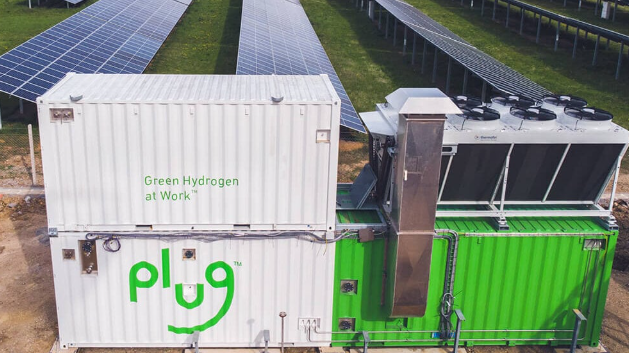
Though nuclear hydrogen is the primary focus of the lab’s input, Mach2H2 is a sprawling, diverse collaboration that includes ExxonMobil, which is likely pitching the natural gas angle (shocker!), while green hydrogen stakeholders Plug Power and Nikola work the non-fossil levers, along with Scout Clean Energy pushing the case for wind and solar.