The new GM logo is seen on the facade of the General Motors headquarters in Detroit, Michigan, U.S., March 16, 2021.
A GM spokesperson clarified that the shift in production at Toledo aligns with market demand and manufacturing needs, not external factors like tariffs. "General Motors will revise production plans at Toledo Propulsion to support additional capacity of ICE (internal combustion engine) propulsion units in alignment with current market demand and manufacturing resiliency," the spokesperson stated.
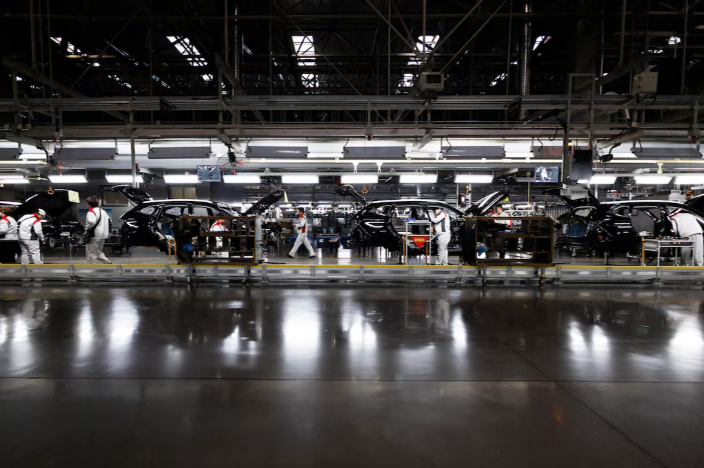
In 2022, GM invested $760 million to convert the Toledo plant into a hub for EV drive unit production, making it the first U.S. powertrain facility repurposed for EVs. However, retail EV drive units have not yet been produced there. To meet current demand, GM decided to repurpose one of the plant’s EV drive unit lines for transmission production. "To align with current market demand and manufacturing needs, leadership has made the decision to add capacity to support propulsion units currently built at Toledo for ICE products," said Rob Morris, the Toledo plant director, in a memo to employees. No updates were provided regarding the second EV drive unit line.
GM has also adjusted its broader EV strategy. The company delayed the start of EV truck production at its Orion Assembly plant in Michigan and fell short of its 2024 goal to produce and wholesale 200,000 EVs in North America, achieving 189,000 units instead.
Separately, recent U.S. tariffs on auto imports, announced in early April, have led some automakers and suppliers to explore increased investments in U.S. manufacturing to mitigate costs. An analysis by the Center for Automotive Research estimates that these 25% tariffs will raise automaker costs in the U.S. by approximately $108 billion in 2025. Additional tariffs on automotive parts are set to take effect by May 3, prompting further industry adjustments.