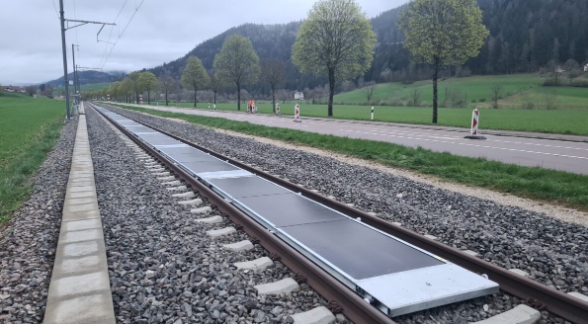
Passenger trains will commence operations over the solar installation on April 28, 2025. The project received approval from Switzerland’s Federal Office of Transport in October 2024, following rigorous testing to ensure safety and compliance. Sun-Ways plans to conduct further studies over the next three years, focusing on panel coatings, soiling effects, and the system’s interaction with rail infrastructure. These tests aim to confirm the setup’s safety and durability for railway operations.
Representatives from Belgium, France, Indonesia, Israel, and South Korea attended the launch, exploring the potential for similar installations in their countries. Sun-Ways highlighted the system’s innovative design, noting: “This technology opens new possibilities for sustainable energy integration in rail networks.”
A recent study by an international research team analyzed the feasibility of photovoltaic systems near or between railway tracks, particularly for rural applications. Published in e-Prime – Advances in Electrical Engineering, Electronics and Energy, the study, titled “Techno-economic study of a photovoltaic power plant besides the railway track for rural uses in Bangladesh,” suggests such projects are both technically viable and economically promising. The researchers noted that in regions like Bangladesh, where tracks rest on soft alluvial soils, vibrations from trains are naturally reduced, minimizing mechanical stress on solar panels.
Concerns about heavy soiling and mechanical wear from passing trains have been raised, as these could affect panel longevity and efficiency. However, the study indicates that strategic design and site selection can mitigate these challenges, making track-mounted solar plants a practical solution for clean energy generation.
This initiative demonstrates a novel approach to combining renewable energy with existing infrastructure, offering a model for sustainable development in rail networks worldwide.