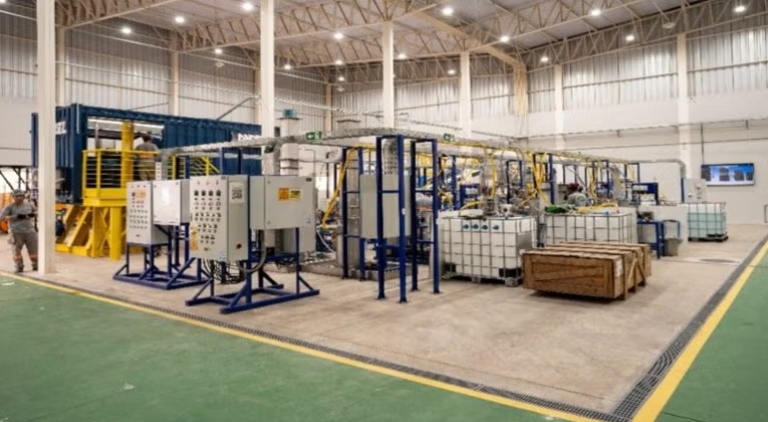
The pilot plant showcases Aclara’s circular mineral harvesting technology.
The plant employs Aclara’s innovative circular mineral harvesting technology, central to the company’s Carina project. This method focuses on efficient processing, cost reduction, and high-purity output. Key features include shallow excavation without blasting, no energy-intensive crushing or milling, zero liquid discharge, over 95% water recirculation, and 99% recovery of primary reagents. The process eliminates the need for tailings dams, ensuring environmental stability.
Building on prior testing in Chile, where 25 tonnes of Carina project clays were processed, the pilot plant validates an optimized closed-circuit flowsheet at a semi-industrial scale. This work supports upcoming pre-feasibility and feasibility studies, conducted with Hatch, and aims to produce high-purity heavy rare earth carbonates for future separation facilities in the United States and to fulfill offtake agreements.
The facility demonstrates environmentally sustainable practices, with processed clays chemically stable for reforestation. Aclara CEO Ramón Barúa stated: “We extend our most sincere gratitude to the Brazilian authorities and the community of Nova Roma for their extensive support and shared commitment to accelerating the implementation of the Carina project. During the inauguration, they experienced firsthand our unique proprietary technology, witnessing how clean and simple our process is for producing critical heavy rare earths such as dysprosium and terbium.”
The Carina project is expected to contribute significantly to global clean energy efforts, with potential production supporting the manufacturing of around five million electric vehicles annually. The process flowsheet is safeguarded by two patents, one granted in Brazil, Chile, the United States, and China, and another awaiting approval.
Goiás Vice-Governor Daniel Vilela remarked: “With an estimated investment of $2.8bn reais ($500m), the project will create thousands of jobs and position our state as a leader in the production of rare earths – strategic minerals for the future of clean technologies such as electric vehicles and wind energy.”
In December last year, Aclara raised $25m through a non-brokered private placement to advance the Carina project, reinforcing its commitment to sustainable rare earth production.