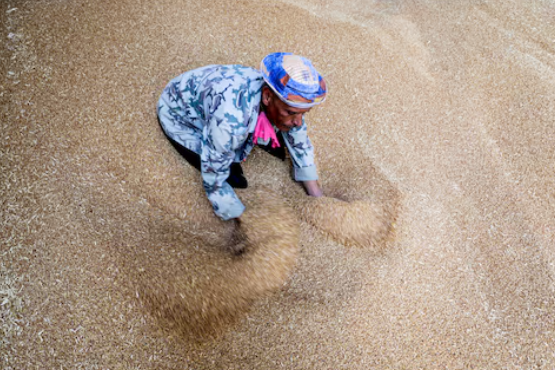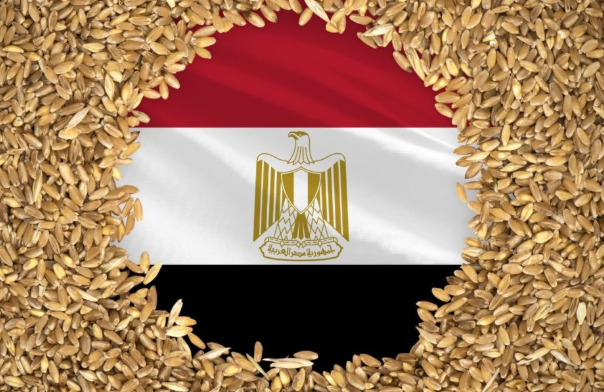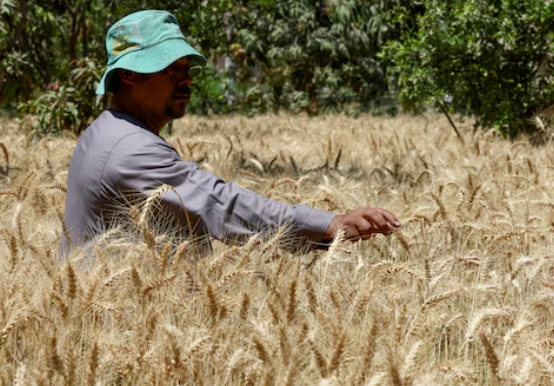
The government’s initiatives aim to strengthen food security and increase self-sufficiency in essential crops. National projects focus on reclaiming agricultural land and boosting crop yields. Modern silos are being developed to minimize waste and preserve wheat quality, ensuring a stable supply chain and supporting market stability.
Wheat holds deep historical significance, with origins tied to ancient civilizations, including Egypt, Mesopotamia, and Babylonia. In ancient Egypt, wheat was offered to deities, as depicted in a 15th-century BC motif from King Menes’ tomb in the Valley of the Kings, showing a farmer presenting a wheat effigy. This symbolism carried into Christianity, where wheat represented goodness and prosperity, and was used in Roman culture to honor goddesses like Hera and Demeter, associated with fertility and growth.
Dr. Badri Ragab, head of the Wheat Research Department at the Agricultural Research Center, provided insights into wheat’s origins: “Most studies indicate that the original homeland of today’s cultivated wheat is the Middle and Near East, based on the fact that two-grain wheat resembles wild species that are widespread in the current time.” He noted that soft bread wheat likely originated in Central Asia and the Near East, while durum wheat emerged in Ethiopia. Wheat cultivation dates back to the Stone Age, around 7,000 BC, with some evidence suggesting it began in Hebron at the end of the Ice Age, around 1,900 BC, before spreading to other regions.
Dr. Ragab further explained: “The Middle East was the ancestral center of wheat, which then spread to the western Mediterranean basin, the southern Soviet Union, and the Near East.” The Roman civilization played a significant role in expanding wheat cultivation across the Mediterranean, Central Europe, and Eastern Europe. The earliest evidence of wheat cultivation appeared in the Fertile Crescent around 9,000 BC.
These efforts and historical insights underscore Egypt’s commitment to advancing wheat production while honoring the crop’s cultural and agricultural legacy. The ongoing harvest season reflects both modern agricultural advancements and a deep-rooted connection to the nation’s heritage.