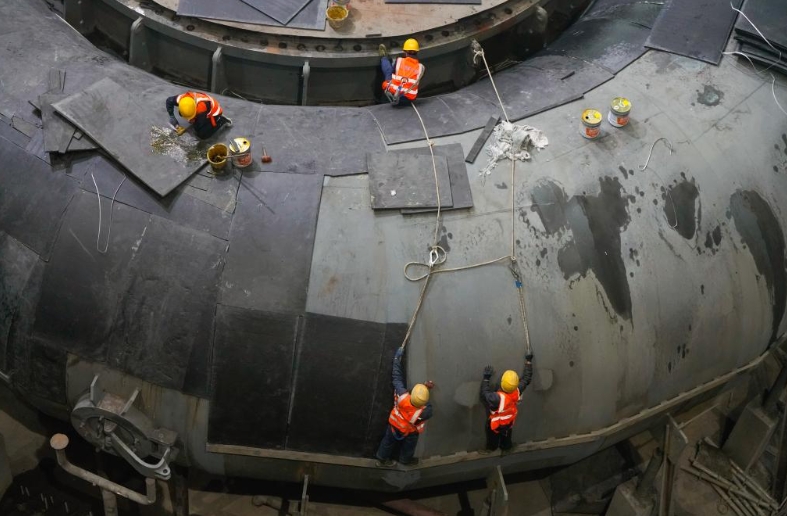
Workers operate at the construction site of Yebatan Hydropower Station in southwest China, Nov. 5, 2024.
The Yebatan Hydropower Station is located at the junction of Baiyu County in Sichuan Province and Konjo County in Xizang Autonomous Region, on the upper reaches of the Jinsha River, a key section of the Yangtze River. Situated at an elevation of nearly 2,900 meters, the 217-meter-tall dam will have an installed capacity of 2.24 million kilowatts, making it one of China’s largest hydropower projects.
The project’s developer noted that the intact 245-millimeter-wide core sample, equivalent to the height of a 12-story building, was drilled vertically through 13 dam sections, spanning 12 horizontal joints and 80 concrete layers. This demonstrates the high quality of the dam’s concrete work, critical for its long-term durability.
The high-altitude site presented significant construction challenges, with temperatures ranging from 37.1 degrees Celsius during the day to minus 23.5 degrees Celsius at night. The project team, working with experts and academicians, utilized smart technologies, including AI-assisted temperature control and winter insulation systems, to ensure successful core extraction.
Construction of the dam’s main structure began in September 2018, with the first generating units scheduled to start operating by late 2025. Once fully operational, the station is projected to produce approximately 10.2 billion kilowatt-hours of electricity annually, supporting China’s west-to-east power transmission initiative.
The Yebatan Hydropower Station is expected to conserve nearly 4 million tonnes of standard coal each year and reduce carbon dioxide emissions by about 7.4 million tonnes annually. This aligns with China’s environmental goals of peaking emissions by 2030 and achieving carbon neutrality by 2060, contributing significantly to sustainable energy development.
The successful extraction of the core sample underscores the project’s technical advancements and its role in bolstering clean energy infrastructure in challenging conditions.