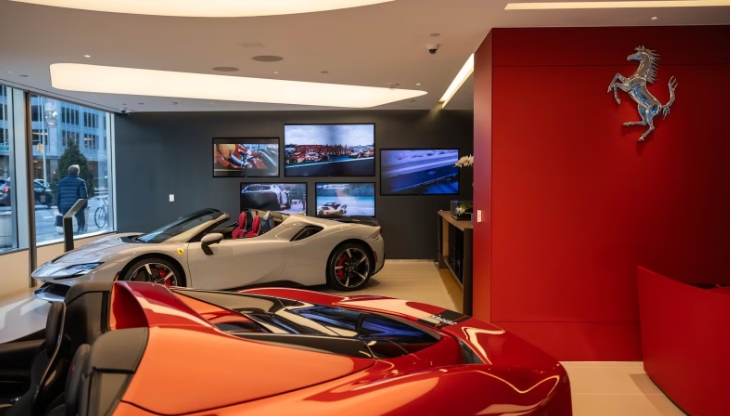
A Ferrari dealership on Park Ave. in New York.
Chief Executive Officer Benedetto Vigna, during an earnings call this week, stated: “One of the cars Ferrari is launching this year will ‘fit better’ for the Greater China region.” He did not specify the model but suggested it would enhance the company’s performance in the region. Ferrari’s sales in Greater China dropped 25% in the first quarter of 2024, reaching the lowest level in nearly four years, amid weakened demand for luxury vehicles.
China’s luxury car market, particularly for vehicles priced above 500,000 yuan ($69,200), contracted by approximately 20% in 2024, falling from 850,000 units annually between 2020 and 2023 to about 677,000 units, according to Shanghai-based consultancy Thinkercar. This decline reflects broader economic challenges and reduced consumer confidence. Local manufacturers, such as BYD Co., are also entering high-end segments, increasing competition for supercar brands like Ferrari.
Ferrari limits shipments to Greater China to roughly 10% of its global total, reducing its exposure compared to other Western automakers. Vigna indicated earlier this year that the company might reconsider this cap as it expands into the EV market. China’s tax policies favor EVs by exempting them from consumption tax, unlike combustion-engine vehicles with engines over four liters, which face a 15% import tariff, 40% consumption tax, and at least 13% VAT.
The Elettrica EV’s lower tax burden is expected to make it more competitive in China, potentially boosting Ferrari’s market share. The company’s focus on EVs aligns with global trends toward sustainable mobility and China’s policies encouraging cleaner vehicles. Ferrari’s largest market remains the U.S., where it plans to adjust some car prices due to import tariffs.
By introducing the Elettrica EV, Ferrari aims to address stagnant sales in China while capitalizing on favorable tax incentives. The move reflects the company’s strategy to adapt to evolving market demands and maintain its position in the luxury vehicle sector, particularly in regions with growing interest in electric vehicles.