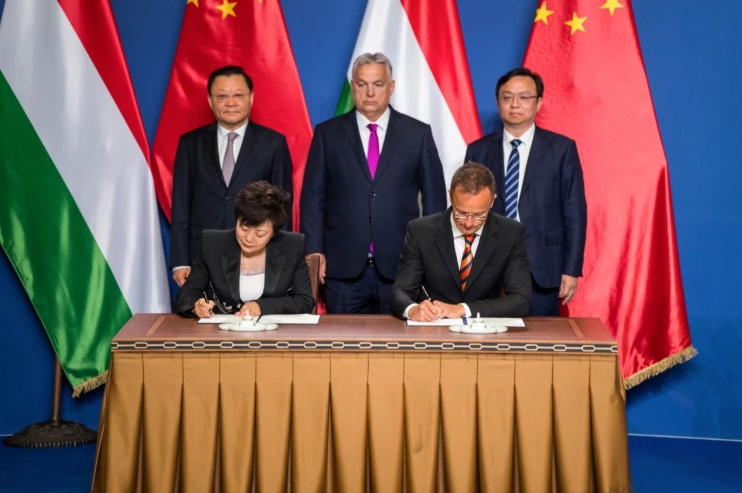
BYD Chairman and President Wang Chuanfu stated: “The launch of our European headquarters marks a deep integration between BYD and Hungary’s local automotive industry. This is not only a significant milestone in BYD’s global expansion but also a testament to the vast potential of China-Hungary cooperation, reinforcing our long-term commitment to the European market.”
The headquarters will oversee sales and after-sales operations, manage vehicle certification and testing, and support model localization and functional development. It is expected to create over 1,000 jobs, contributing to local economic growth. The facility’s research and development efforts will initially focus on intelligent driving assistance and next-generation vehicle electrification technologies. BYD also plans to collaborate with at least three Hungarian universities on joint research and partner with local suppliers to enhance the new energy vehicle (NEV) value chain.
Hungary has been a key partner for BYD since 2016, when the company opened an electric bus manufacturing plant in Komárom. Leveraging Hungary’s strong automotive sector, which is the second-largest electric vehicle manufacturing base globally, BYD further committed to the region in late 2023 by announcing its first European NEV passenger car production facility. The new headquarters strengthens BYD’s ability to tailor products and services for the European market while boosting its brand presence.
The initiative aligns with BYD’s strategy to support sustainable transportation and meet growing consumer demand for new energy vehicles in Europe. By integrating with Hungary’s industrial ecosystem, the headquarters enhances local production capabilities and fosters innovation in the NEV sector. This development also highlights the potential for collaborative economic partnerships, supporting job creation and technological advancement in the region.
The Budapest headquarters underscores BYD’s commitment to sustainable energy solutions, reinforcing its role in advancing clean transportation while contributing to Hungary’s economy and Europe’s green mobility goals.