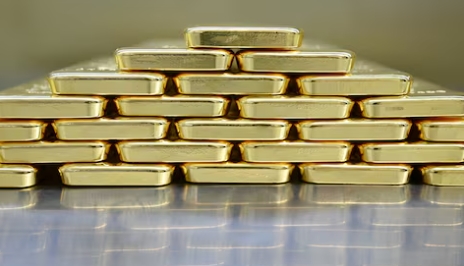
Gold bars are stacked in the safe deposit boxes room of the Pro Aurum gold house in Munich, Germany, January 10, 2025.
Spot gold declined 1.2% to $3,302.10 per ounce by 2:03 p.m. ET (1802 GMT), following a nearly 5% gain last week. Gold futures also dropped, settling 1.9% lower at $3,300.40.
Bart Melek, head of commodity strategies at TD Securities, noted: "There is a lot of volatility in gold prices as we keep having things change on the tariff front. Currently, the market may be under the impression that there is a deal to be had and that is pressuring gold."
A weekend phone call between Trump and EU chief Ursula von der Leyen provided fresh momentum for trade discussions, according to the EU, after Trump postponed his plan to impose 50% tariffs on EU imports next month.
The U.S. dollar gained strength, and stock index futures rose, contributing to the downward pressure on gold, a dollar-denominated asset often sought during times of economic or geopolitical uncertainty.
Neel Kashkari, President of the Federal Reserve Bank of Minneapolis, emphasized the need to maintain steady interest rates until the impact of higher tariffs on inflation becomes clearer. Investors are awaiting the release of the Federal Reserve’s latest policy meeting minutes on Wednesday, alongside key U.S. economic data, including the first-quarter GDP estimate, weekly unemployment claims, and the core PCE price index.
Despite the current dip, Melek remained optimistic about gold’s outlook, stating: "Our longer term bullish view on gold has not changed. As soon as the market believes that the Fed is going to cut (rates), gold will start doing well." Gold, which yields no interest, typically performs strongly in low-interest-rate environments.
In other metals markets, spot silver edged down 0.4% to $33.21 per ounce, platinum dipped 0.1% to $1,084.02, and palladium fell 1.2% to $975.49.