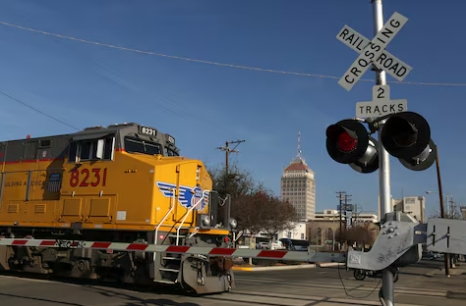
A freight locomotive rolls across an intersection in Fresno, California January 6, 2015.
 The California High-Speed Rail Authority responded, stating: “We strongly disagree with the administration’s conclusions, which are misguided and do not reflect the substantial progress made to deliver high-speed rail in California.” The authority emphasized ongoing efforts, including active construction along 119 miles in the Central Valley as of May and a proposed budget from Governor Gavin Newsom that allocates at least $1 billion annually for the next 20 years to support the project’s initial phase.
The planned 800-mile rail system aims to connect San Francisco to Los Angeles/Anaheim in its first phase, with speeds reaching 220 miles per hour. A second phase would extend the network to Sacramento and San Diego. Initially approved by voters in 2008 with a $10 billion budget, the project’s costs have escalated from $33 billion to an estimated $89 billion to $128 billion for the San Francisco-to-Los Angeles segment. The original completion date of 2020 has also been delayed.
The report criticized the project’s management, stating: “California had conned the taxpayer out of its $4 billion investment, with no viable plan to deliver even that partial segment on time.” Previously, in 2021, the Biden administration restored a $929 million grant that had been revoked in 2019, when the project was labeled a “disaster.” Despite these challenges, the California High-Speed Rail Authority remains committed to advancing the project, citing its potential to enhance transportation infrastructure.
The ongoing developments highlight the complexities of funding and constructing a major rail initiative. California continues to address financial and logistical hurdles while emphasizing progress in the Central Valley and long-term funding commitments to ensure the project’s completion.