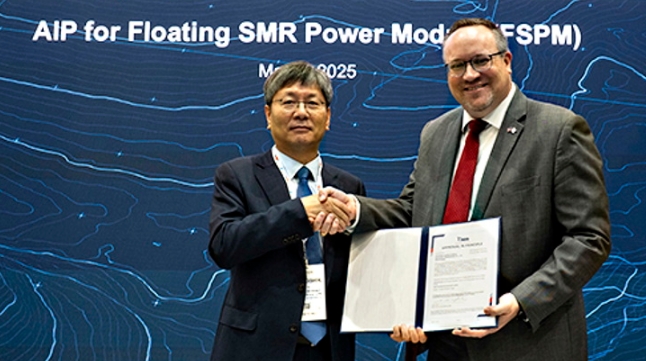
Kwang-Sik Won, Senior Executive Vice President of HD HHI Offshore Business Division (left), with Patrick Ryan of ABS
The ABS conducted design reviews in accordance with its Requirements for Nuclear Power Systems for Marine and Offshore Applications, introduced in October 2024 as the industry’s first comprehensive guidelines for floating nuclear power plants. The Approval in Principle, part of ABS’s Novel Concept Class Approval process, verifies the design’s feasibility during the early conceptual phase, ensuring compliance with relevant ABS rules, industry standards, and specific conditions. Nuclear regulators are responsible for licensing the reactor and related safety systems.
Patrick Ryan, ABS Senior Vice President and Chief Technology Officer, stated: “Floating nuclear power facilities show promise in supporting power grids, microgrids, industrial and port operations, data centres, and other uses. Additionally, today’s advanced nuclear technology has a different risk profile from traditional reactor technology with state-of-the-art designs and with lower enrichment fuels, making commercial offshore and maritime applications more viable.”
An HD Korea Shipbuilding & Offshore Engineering spokesperson said: “The floating nuclear power plant is expected to play a key role in building a future powered by clean energy. We will remain fully committed to developing the necessary technologies and ensuring its successful realisation.”
This marks the second Approval in Principle from ABS to HD Korea Shipbuilding & Offshore Engineering for a floating nuclear power design. In October 2023, ABS approved a floating offshore nuclear power barge intended for remote communities and island electrification. Additionally, HD Korea Shipbuilding & Offshore Engineering previously secured ABS approval for a 15,000 TEU-class container ship design powered by SMR technology. In February 2025, the company introduced another SMR-powered container ship model, featuring improved economic efficiency and advanced safety measures through refined equipment and safety design concepts.
The development of these floating nuclear power modules highlights the potential of SMR technology to provide sustainable energy solutions for diverse applications, from port operations to remote power generation, while prioritizing safety and efficiency.