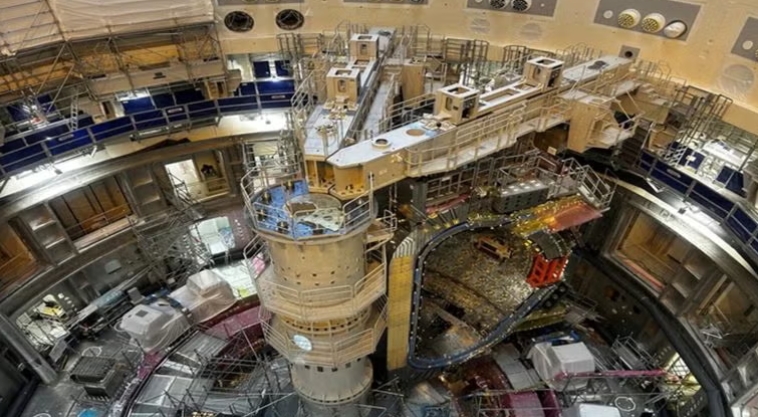
The ITER Tokamak pit with the two vacuum vessel sector modules installed.
The vacuum vessel is considered the most essential component of the ITER reactor. It is a double-walled steel chamber designed to contain high-energy plasma required for the fusion process. Westinghouse is tasked with final assembly and welding of nine sectors to form a single, sealed toroidal structure.
Dan Sumner, Interim CEO of Westinghouse, stated: “Westinghouse has always been at the forefront of energy innovation, and we are proud to work with ITER on this breakthrough initiative that could ensure energy security for generations to come. Our expert teams look forward to bringing our world-class capabilities and expertise to the completion of this important project.”
Westinghouse has collaborated with ITER for over a decade, contributing to the production of key reactor components. This includes manufacturing five sectors of the vacuum vessel, in cooperation with Ansaldo Nucleare and Walter Tosto. The company has also developed fabrication methods that meet ITER’s rigorous quality standards.
ITER Director-General Pietro Barabaschi remarked: “ITER is pleased to have Westinghouse Electric Company taking on this significant role in our first-of-a-kind project. With decades of leadership in nuclear power plant design and construction, we are confident that Westinghouse will be able to apply its remarkable expertise to the assembly of the ITER Tokamak.”
The ITER project aims to demonstrate the feasibility of nuclear fusion as a sustainable energy source. By replicating the process that powers the sun—where light atomic nuclei fuse and release energy—fusion has the potential to deliver reliable, zero-carbon electricity at scale.
The vacuum vessel, once completed, will serve as the core structure of the ITER Tokamak, maintaining a vacuum environment and supporting the magnetic field systems necessary for plasma confinement.
In addition to its work with ITER, Westinghouse Electric signed an early works agreement in June 2025 with Fortum to explore deployment of the AP1000 advanced reactor technology in the Nordic region. This agreement reflects growing interest in nuclear solutions to meet increasing energy demands while maintaining environmental standards.
Westinghouse’s continued involvement in both nuclear fission and fusion projects positions the company as a key contributor to the evolving global energy landscape.