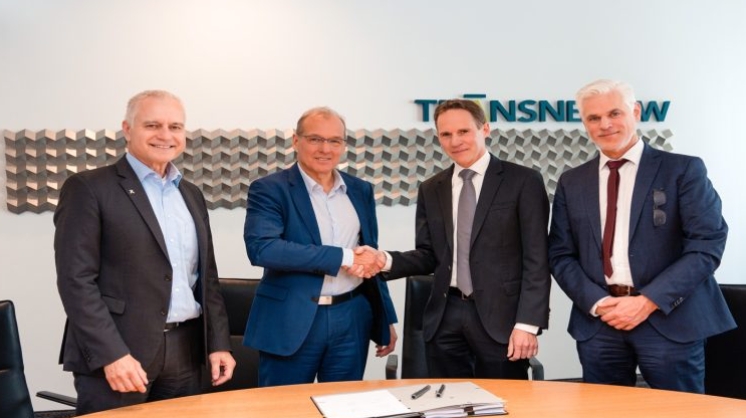
From left to right: Dr. Rainer Pflaum – CFO, TransnetBW GmbH Dr. Werner Götz – CEO, TransnetBW GmbH, Johan Bindele – Vice President and CEO of Grid Systems Integration at GE Vernova and Stefan Hartge – Regional Leader for GSI, GE Vernova.
The modernization project aims to enhance frequency regulation, voltage stability, and power transfer capabilities. It is part of Germany’s broader efforts to strengthen its electrical infrastructure, enabling better integration of renewable energy sources and improved management of increased power flows across Europe’s interconnected grids. The upgraded substation will boost capacity and reliability, ensuring a stable electricity supply in south-western Baden-Württemberg.
TransnetBW CFO Rainer Pflaum stated: “At the substation Kühmoos of TransnetBW, we are reinforcing a vital energy hub for both Germany and our neighbouring countries, France and Switzerland. The collaboration with GE Vernova supports our ambition to expand and future-proof our transmission network while continuing to operate reliably and safely.”
GE Vernova’s grid solutions division will deliver a new 380kV gas-insulated substation (GIS) on a turnkey basis, replacing outdated air-insulated switchgear technology. The new GIS is expected to double the substation’s capacity while requiring less space, allowing construction to proceed without disrupting ongoing operations. The upgrade includes 15 bays of compact GIS technology and a four-main busbar system to optimize power distribution.
The project also incorporates a mechanical switched capacitor with damping network (MSCDN) to improve voltage regulation and reduce energy losses as higher electricity volumes flow through the network. This modernization is a significant step toward building a resilient and future-ready grid infrastructure.
GE Vernova grid systems integration vice-president and CEO Johan Bindele stated: “This is a landmark project for the region and a proud moment for GE Vernova. Modernising critical grid nodes like Kühmoos is essential for supporting the long-term reliability of Europe’s power system, especially as countries expand their use of renewables and seek greater interconnection across borders. Europe is our largest market for electrification, and we are deeply committed to supporting its energy transition.”
In a related development, GE Vernova recently began operations for the first block of the Hsinta power plant, managed by the Taiwan Power Company Nan Bu Construction Organisation. Equipped with GE Vernova’s advanced 7HA.03 combined cycle technology, the block delivers 1.3GW of electricity to Taiwan’s energy grid, supporting the region’s energy needs.
This project underscores the importance of modernizing critical infrastructure to support the growing demand for renewable energy and cross-border power exchange, contributing to a reliable and sustainable energy future.