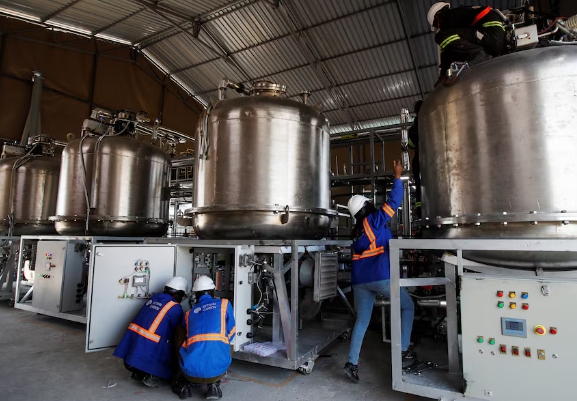
Workers regulate Direct Air Carbon capture machines used to filter carbon dioxide at Octavia Carbon, a Direct Air Carbon Capture (DAC) company that captures CO2 using a chemical process and stores it underground, in Kikopey area of Naivasha in Nakuru County, Kenya February 27, 2025.
Engineer Hannah Wanjau of Octavia Carbon said: “We've already seen the effects of climate change, so we want something that's going to work very fast, and remove huge amounts of CO2.” Kenya’s abundant geothermal steam and basalt formations enable efficient operation and safe CO2 storage. The country’s skilled workforce, bolstered by government investment in education, supports this innovation.
Each prototype captures 10 tons of CO2 yearly, comparable to 1,000 trees, generating carbon credits for offsetting emissions. A University of Oxford report estimates seven to nine billion tons of CO2 must be removed annually by mid-century to limit warming to 1.5 degrees Celsius, a goal unmet last year. Martin Freimüller, Octavia’s co-founder, admitted: “Critics would be right to point out that what we currently do is a drop in the ocean.” He plans a 1,000-ton-per-year plant by next year, stating: “But the point is that scaling from 1,000 tons to a billion tons, still starts with 1,000 tons.”
While some environmental groups view carbon capture as a distraction from renewable energy transitions, the UN’s climate panel underscores its necessity for sectors like cement and steel. Octavia’s partnership with Cella Mineral Storage aims to store CO2 underground starting next year, following Iceland’s lead. The company has secured $3 million in carbon credit contracts, covering 40% of the planned plant’s capacity.