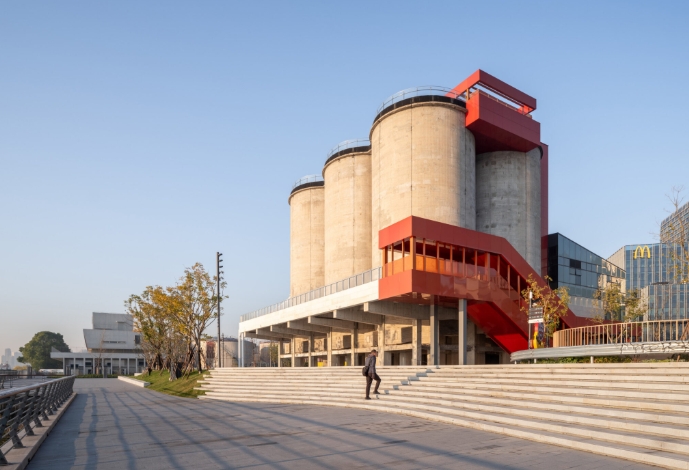
The design integrates the site’s robust industrial structures with modern amenities, preserving their historical value while fostering a welcoming environment. Jacob van Rijs, MVRDV founder, stated: “It was clear from the start that there was a lot of value leftover in the buildings that were already there – we didn’t want to demolish things just because it might be simpler, because that means more carbon, more waste.” He added: “Our challenge was to bring these pieces together and make them work as a single area, because they were an awkward pairing. We turned the newer buildings into the backdrop, so that the industrial behemoths could be the exclamation points.”
The M Factory, a key feature, houses a food market and restaurant on its ground floor and a spacious cultural venue upstairs. Former cement silos have been transformed into a rock-climbing center, while incomplete structures from the prior project now serve as shops, restaurants, and hotels with green roofs and outdoor terraces. A skatepark further enhances the area’s recreational offerings. Bright orange circulation elements, such as a repurposed conveyor belt now serving as a staircase, connect the spaces, adding a vibrant touch to the district.
Additional architectural firms contributed to the project. Schmidt Hammer Lassen designed the West Bund Dome Art Centre and the Shanghai West Bund Theatre in the northern section, while Atelier Deshaus crafted commercial buildings, enriching the area’s cultural and retail landscape.
The GATE M Dream Center blends Shanghai’s industrial heritage with contemporary design, creating an inviting destination for leisure and culture. By reusing existing structures, the project minimizes environmental impact and supports sustainable urban development, offering a model for revitalizing industrial sites into community-focused spaces along the Huangpu River.