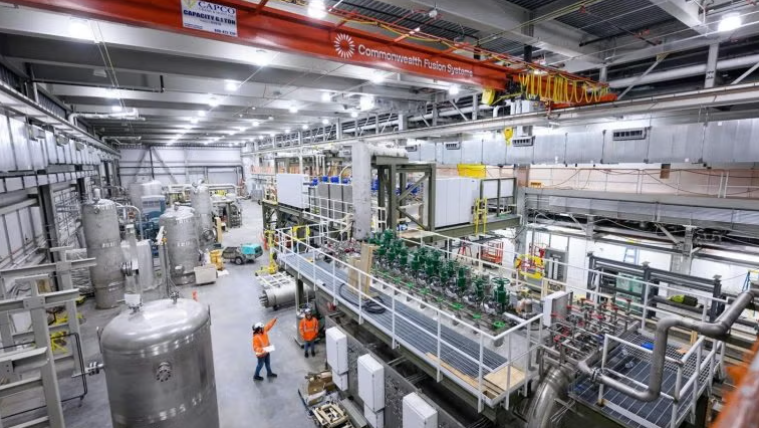
A view of the construction site of fusion startup Helion's first power plant in Malaga, Washington, U.S., in this handout photo taken on July 14, 2025.
Pending final state permits, Helion’s project remains on schedule to fulfill a 2023 power supply agreement with Microsoft. The plant, named Orion, will integrate with Washington’s primary power grid, close to Microsoft’s data infrastructure.
David Kirtley, Helion’s co-founder and CEO, told Reuters: "We'll actually be able to connect to the exact same grid just upstream of the Microsoft data centers." The company is refining its fusion technology using the Polaris prototype in Everett, Washington, where Orion’s components will also be built.
Fusion energy, generated by colliding atoms, produces minimal greenhouse gas emissions and limited radioactive waste. However, creating a process that yields more energy than it consumes remains a global challenge.
Microsoft supports a mix of clean energy solutions, including fission-based nuclear power, and views fusion as a promising long-term option. Melanie Nakagawa, Microsoft’s chief sustainability officer, told Reuters: "Over the last three, four years, you’ve been seeing from across the fusion space different types of milestones being met by other companies and peers, Helion included. There’s a lot of optimism that this could be the moment that fusion actually comes forward within this decade, or near in this decade."