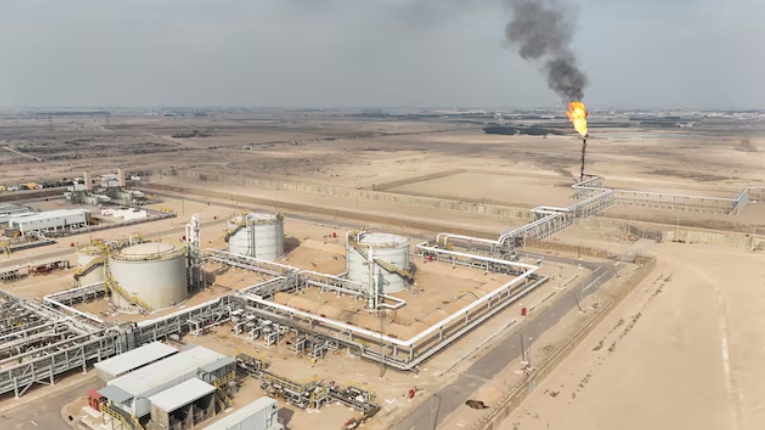
A drone view shows the Zubair Oil Field in Basra, Iraq, January 16, 2025.
Smaller Chinese firms, such as Geo-Jade Petroleum Corp, United Energy Group, Zhongman Petroleum and Natural Gas Group, and Anton Oilfield Services Group, have gained prominence by securing half of Iraq’s exploration licensing rounds last year. These companies, often managed by former employees of China’s state-owned oil giants, leverage lower costs and faster project timelines to develop smaller oilfields in Iraq. For instance, they can develop an oilfield in two to three years, compared to five to ten years for Western companies, and have reduced drilling costs to between $4 million and $5 million per well, roughly half the cost from a decade ago.
Iraq’s shift to profit-sharing contracts in 2024, moving away from fixed-fee agreements, has attracted these independent firms. These contracts, designed to accelerate projects, followed reduced involvement by global majors like ExxonMobil and Shell. Chinese firms offer competitive financing, utilize cost-effective labor and equipment, and are willing to accept lower profit margins for long-term contracts. Ali Abdulameer from Basra Oil Co. noted: “They are known for rapid project execution, strict adherence to timelines, and a high tolerance for operating in areas with security challenges. Doing business with the Chinese is much easier and less complicated, compared to Western companies.”
A notable project involves a Geo-Jade-led consortium investing $848 million in the South Basra project, aiming to increase the Tuba field’s output to 40,000 barrels per day by mid-2027. The initiative also includes plans for a 200,000-barrel-per-day refinery, a petrochemical complex, and two power stations, requiring multi-billion-dollar investments. Similarly, Zhenhua Oil, in partnership with CNPC, plans to double its production at the Ahdab oilfield to 250,000 barrels per day by 2030. Zhongman Petroleum announced a $481 million investment in June 2024 for the Middle Euphrates and East Baghdad North blocks.
While these projects highlight cost efficiencies, some concerns exist. Muwafaq Abbas, a former Basra Oil manager, said: “Transparency and technical standards among Chinese firms have faced criticism for relying heavily on Chinese staff and relegating Iraqis to lower-paid roles.” Meanwhile, Iraq continues to attract Western firms, with TotalEnergies launching a $27 billion project in 2023 and BP planning up to $25 billion to redevelop fields in the Kurdish region.