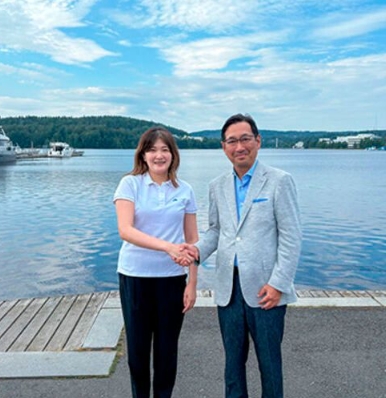
Haruka Arai, Executive Director of Cefmof (left), and Kenji Takeda, Executive Officer of Asahi Kasei (right), by Lake Jyväsjärvi.
Asahi Kasei has been involved in the chlor-alkali electrolysis business since 1975, leveraging its extensive technology and expertise to develop water electrolysis systems for hydrogen production. In 2020, the company installed a large-scale 10 MW-class Aqualyzer electrolyzer at the Fukushima Hydrogen Energy Research Field (FH2R) in Japan. Following the success of the FH2R project, Asahi Kasei launched the Aqualyzer-C3 in 2024. This smaller, containerized system, ranging from 1 to 7.5 MW, allows Asahi Kasei to meet the increasing demand for hydrogen across various industries.
Cefmof, founded by the City of Jyväskylä, Toyota Gazoo Racing World Rally Team, and the Toyota Mobility Foundation, focuses on accelerating sustainable mobility and urban planning through green hydrogen. The foundation aims to make hydrogen utilization visible in everyday life, particularly in cold climates, by supporting projects like hydrogen-powered transport and infrastructure. Cefmof plans to use fuel cell vehicles and hydrogen buses as a model for the potential of hydrogen in the mobility industry.
For its hydrogen production, Cefmof selected Asahi Kasei's 1 MW containerized Aqualyzer-C3 system due to its reliability and easy scalability to meet growing demand. The installation of the system in Jyväskylä is expected to begin towards the end of 2025, with full operation planned for the first half of 2026. The system is designed to produce enough hydrogen in one hour to refuel approximately three fuel cell vehicles (FCVs), contributing to the region’s growing hydrogen infrastructure.
This partnership highlights the role of green hydrogen in advancing sustainable mobility and environmental goals, with Asahi Kasei’s technology playing a significant role in meeting the energy needs of the region.