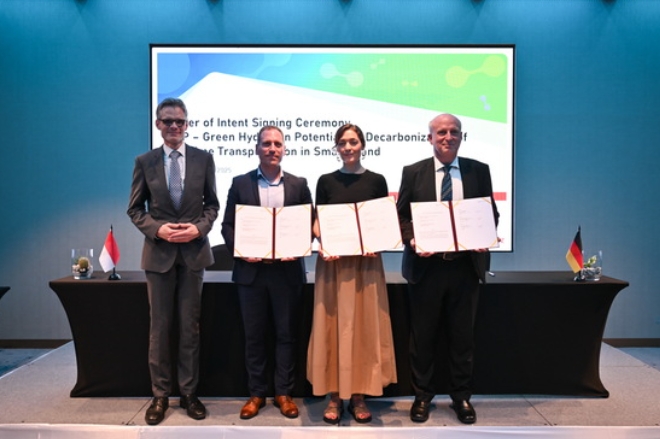
Supported by GIZ under the International Hydrogen Ramp-Up Program (H2Uppp), the partnership will lead a feasibility study focused on hybrid hydrogen and battery-powered ferry systems. The goal is to develop a technical and financial blueprint for providing reliable, clean, and scalable interisland transport, aligning with Indonesia's National Hydrogen Roadmap and Net Zero Emission Roadmap for the energy sector.
The project is also backed by the International Maritime Organization (IMO) and is expected to set a reference for future pilot projects in Indonesia and beyond, involving both public and private sector stakeholders.
Atiek Puspa Fadhilah, Advisor for GIZ Indonesia, emphasized the importance of the initiative: “The two worlds of maritime and energy transition go together. There is a demand from the maritime sector, and a push for energy transition in Indonesia, which are the Net-zero Emission Roadmap for the Energy Sector and the Hydrogen Roadmap which has been published recently. While the hydrogen strategy for maritime transport will start in 2030, it would be optimal that we start working on contributing the solutions now. With our project’s objective centering around solutions to decarbonise ferry transport in the small island context, it is my hope that the result from our project will contribute to the push for decarbonisation of the maritime transport in Indonesia and beyond.”
In addition to this collaboration, HDF Energy recently signed two strategic agreements to accelerate the deployment of its Renewstable hydrogen power plants in Indonesia. Furthermore, its subsidiary PT HDF Energy Indonesia signed a memorandum of understanding (MoU) earlier this year to explore green hydrogen solutions for decarbonizing the country’s maritime sector. This partnership represents a significant step forward in Indonesia's efforts to decarbonize its transport industry and contribute to global energy transition goals.