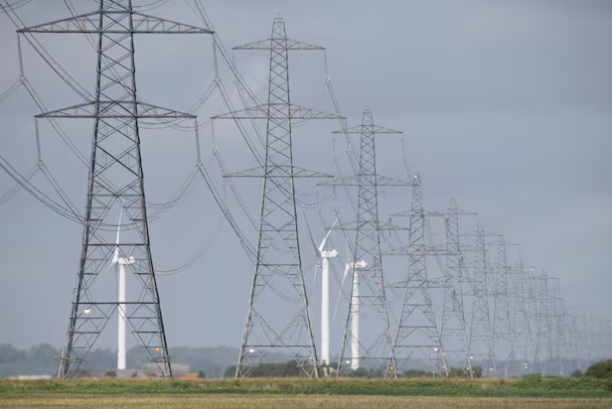
Windmills are seen behind electricity pylons in Palm Springs, California, U.S., November 25, 2017.
This rise in electricity use is driven by growing demand from data centers supporting artificial intelligence and cryptocurrency, as well as increased reliance on electricity for heating and transportation in homes and businesses. The EIA estimates 2025 power sales will reach 1,515 billion kWh for residential consumers, 1,476 billion kWh for commercial customers, and 1,051 billion kWh for industrial customers. These figures compare to historical peaks of 1,509 billion kWh for residential users in 2022, 1,434 billion kWh for commercial users in 2024, and 1,064 billion kWh for industrial users in 2000.
The EIA also outlined shifts in power generation sources. Natural gas is expected to account for 40% of U.S. power generation in 2025 and 2026, down from 42% in 2024. Coal’s share will increase slightly to 17% in 2025 from 16% in 2024, then decline to 15% in 2026 as renewable energy grows. Renewable sources are projected to rise from 23% in 2024 to 24% in 2025 and 26% in 2026. Nuclear power’s contribution is expected to decrease from 19% in 2024 to 18% in both 2025 and 2026.
Natural gas sales for 2025 are forecasted to increase to 13.1 billion cubic feet per day (bcfd) for residential consumers, 9.7 bcfd for commercial customers, and 23.5 bcfd for industrial customers. However, gas used for power generation is expected to decline to 35.8 bcfd in 2025, compared to a 2024 peak of 36.9 bcfd. Historical highs for gas sales include 14.3 bcfd for residential users in 1996, 9.6 bcfd for commercial users in 2019, and 23.8 bcfd for industrial users in 1973.
In a separate development, Danish wind farm developer Orsted announced on August 11, 2025, a $9.4 billion rights issue, citing challenges in the U.S. offshore wind market. The company stated: “This rights issue is a proactive step to strengthen our financial position amid adverse developments in the U.S. offshore wind sector.” The growing demand for electricity and the shift toward renewables highlight the evolving energy landscape in the United States.