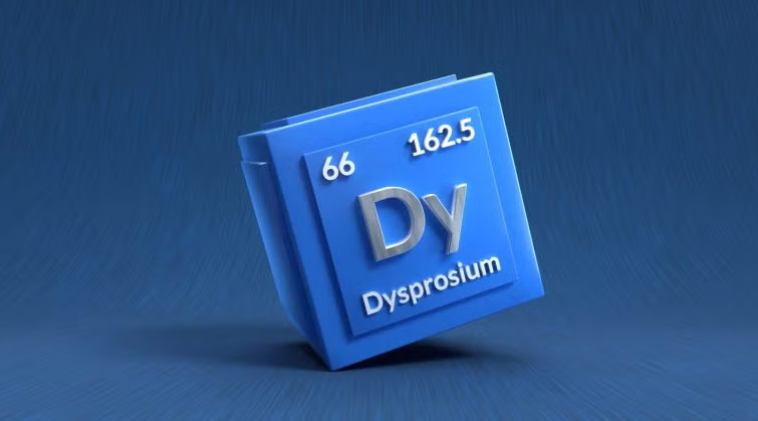
Energy Fuels claims to be the first US company to produce high-purity Dy oxide and disclose production volumes and purities publicly.
The company is preparing to advance production of terbium (Tb), with initial samples expected for end-user validation by the fourth quarter of 2025. Energy Fuels emphasized that its Dy oxide is derived from monazite mined in Florida and Georgia, marking progress in building a rare earth oxide supply chain outside of China. According to the company, it is the first in the US to achieve high-purity Dy oxide production while publicly disclosing volumes and purities.
This development has attracted significant attention from magnet manufacturers and original equipment manufacturers (OEMs) interested in accelerating validation processes with the company’s samples. Energy Fuels also intends to construct and commission commercial-scale separation capacity for Dy, Tb and other heavy rare earth elements at the White Mesa Mill, with potential production to begin as early as the fourth quarter of 2026.
The achievement builds on earlier milestones. Last year, the company completed commissioning of its commercial-scale light rare earth oxide circuit at the mill. It successfully produced on-spec neodymium-praseodymium (NdPr) oxide, which has been tested and qualified by global magnet makers. This material is expected to be used in various technologies, including electric and hybrid vehicles entering markets in the US, EU and Asia this year.
In October 2024, Energy Fuels further expanded its operations by acquiring Australian critical minerals company Base Resources. The transaction was valued at approximately $178.4 million (A$260.22 million). This acquisition was part of the company’s broader strategy to enhance its position in the rare earth and critical minerals sector.
Energy Fuels’ recent steps highlight its ongoing efforts to expand its production capabilities and develop both light and heavy rare earth oxide supply chains. The combination of new Dy oxide production, progress in Tb development, and the earlier success in NdPr production demonstrates a multi-stage strategy aimed at supplying high-purity materials for advanced technologies and meeting growing demand in global markets.