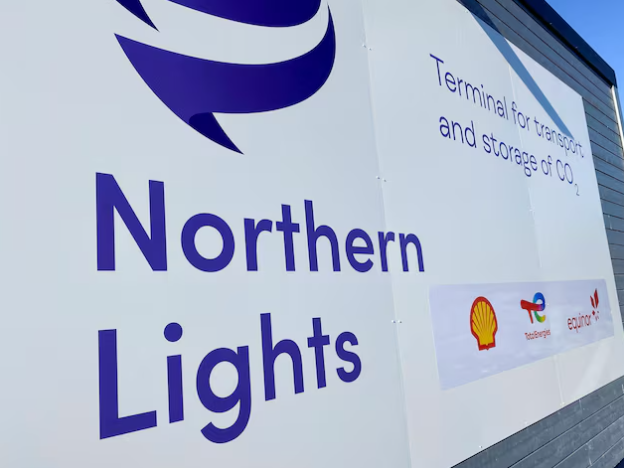
A view of a signage with the logos of Northern Lights carbon dioxide project and other corporates, outside the facility in Oygarden, Norway October 18, 2022.
The CO2 is stored in a reservoir located 2,600 meters below the seabed. The companies highlighted the achievement as a key step in demonstrating the viability of CCS as an industry capable of scaling. Anders Opedal, CEO of Equinor, stated: "This demonstrates the viability of carbon capture, transport and storage as a scalable industry."
The facility forms part of Norway's Longship project, which is supported by significant government subsidies. The initiative is designed to develop commercial CCS solutions to reduce emissions, particularly in industries that depend on fossil fuel inputs and face challenges in transitioning to low-carbon alternatives.
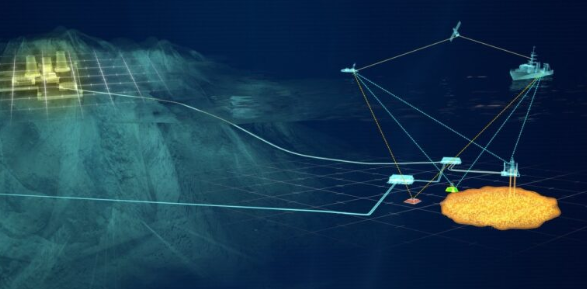
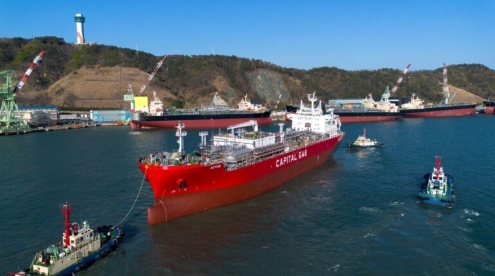
The CO2 used in the first injection came from the Brevik cement factory in southern Norway, operated by Heidelberg Materials. The captured CO2 was first transported to onshore tanks and then delivered through a 100-kilometer pipeline to the offshore storage site beneath the seabed. This process represents the first practical use of the Northern Lights infrastructure for permanent CO2 storage.
Completion of the injection marks the end of phase one of the Northern Lights project. This stage has the capacity to store 37.5 million metric tons of CO2 over 25 years, equal to about 1.5 million tons annually. The capacity for this phase has already been fully allocated.
Looking ahead, Shell, Equinor, and TotalEnergies have confirmed plans for a second phase of the project. The companies have committed to invest 7.5 billion Norwegian crowns, or approximately $743.93 million, into expanding the facility. The second phase aims to increase capacity by an additional 3.5 million tons of CO2 per year.
The Northern Lights project, in combination with the Longship program, is intended to establish CCS as a commercially viable option for industries seeking to reduce carbon emissions. By capturing CO2 from industrial sources and storing it deep underground, the project provides an alternative for sectors that cannot easily transition away from fossil fuels.
With the start of operations, Norway becomes one of the first countries to launch full-scale CCS storage in Europe. The initiative is seen as a model for the potential development of similar projects in other regions. The progress achieved so far underscores the growing role of CCS in global strategies for reducing greenhouse gas emissions.