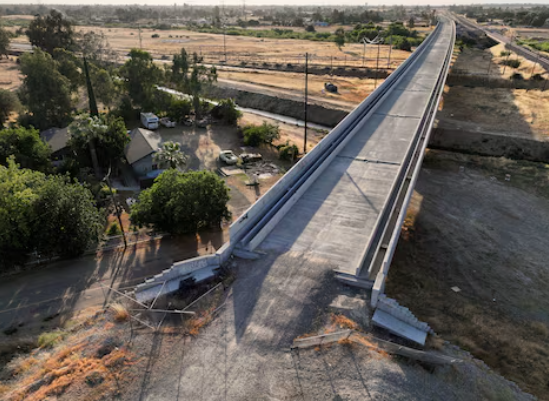
A drone view of a California High-Speed Rail Bridge as it crosses over the Fresno River in Madera, California, U.S. June 7, 2025.
The California High-Speed Rail Authority, responsible for overseeing the project, stated on Tuesday: “The announcement is a continuation of the Trump Administration’s illegal, politically motivated, and baseless attack on California High-Speed Rail and Central Valley communities... While opponents are recycling tired political attacks, California is building the future of American transportation.” The authority has challenged the funding cuts, filing a lawsuit in July to contest the earlier $4 billion withdrawal, asserting that the decision lacks legal grounds.
Initiated with a $10 billion bond approved by California voters in 2008, the high-speed rail project aims to connect Los Angeles and San Francisco with a three-hour train journey, offering the fastest passenger rail service in the United States. The project has made progress, completing over 50 major structures, such as bridges, overpasses, under-crossings, and viaducts, along with 70 miles of guideway. However, the San Francisco-to-Los Angeles route, originally planned for completion by 2020 at a cost of $33 billion, now faces a projected cost of $89 billion to $128 billion, with service expected to begin by 2033.
The funding reductions present significant challenges to the 16-year effort to transform transportation in California. The project’s rising costs and delayed timeline have sparked ongoing debates about its feasibility. A previous attempt in 2019 to cancel $929 million in federal grants was overturned in June 2021, restoring the full amount. The current cancellations add to the obstacles faced by the California High-Speed Rail Authority as it works to advance the initiative.
The decision reflects broader tensions between federal and state priorities, with California emphasizing the project’s role in modernizing transportation infrastructure. Despite the setbacks, the state remains committed to advancing the rail system, which is seen as a key step toward sustainable and efficient travel for millions of residents.