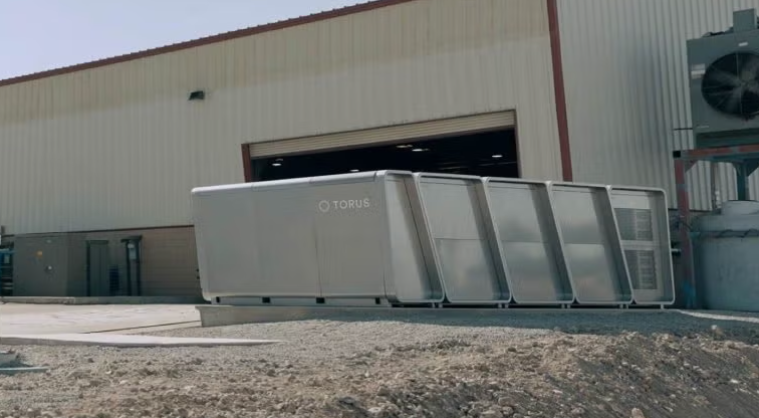
Each Torus unit is capable of responding to grid signals within milliseconds
The modular plants are small, inertia-based hybrid systems that combine mechanical flywheels with battery storage. This integration provides both rapid power delivery and long-duration energy storage. Each unit also incorporates enterprise-grade security and advanced software management. Torus highlighted that these systems can be installed at the grid edge or directly at customer sites, responding to grid signals within milliseconds. When interconnected, the units operate as a distributed grid platform, offering utilities and businesses scalable, reliable, and secure energy solutions.
Nate Walkingshaw, co-founder and CEO of Torus, said: “With this investment, we’re building the world’s first distributed utility – connecting small inertial power plants that deliver grid-scale performance at the edge. Our technology has already been deployed more than 230 times this year with over 1GW of facility managed power, proving it’s no longer experimental but essential.”
The company emphasized that demand for its technology is particularly strong among data centers, which are facing rapid growth due to artificial intelligence and cloud computing. Hyperscale operators need systems that can handle variable loads with both speed and dependability. Torus’ hybrid model, offering true inertia and millisecond-level response, is designed to outperform traditional chemical battery-only solutions. With a reported 99.9% uptime, Torus systems aim to provide operators with reliable tools for maintaining critical facilities online, while also supporting utilities at the sub-transmission and distribution levels.
Magnetar managing director Neil Tiwari noted: “Torus has built one of the most compelling distributed utility platforms we’ve seen. The architecture is reliable, it scales, and it’s coming to market at a time when demand from AI and electrification is surging. We’re excited to leverage our experience investing in high-performance data centers and AI infrastructure to support Torus’ proven team as it builds the grid of the future.”
Alongside the investment, Torus is expanding partnerships. The company signed a memorandum of understanding with PacifiCorp to deliver up to 500MW of demand response capacity. This builds on a previously completed 70MW agreement earlier in the year, which Torus fulfilled within six months.
The combination of new funding, growing demand from data-intensive industries, and expanded partnerships positions Torus to play a central role in modernizing energy systems. By integrating flywheel-based inertia with battery storage and software-driven management, the company aims to provide resilient, scalable solutions that align with evolving power needs in the U.S. energy landscape.