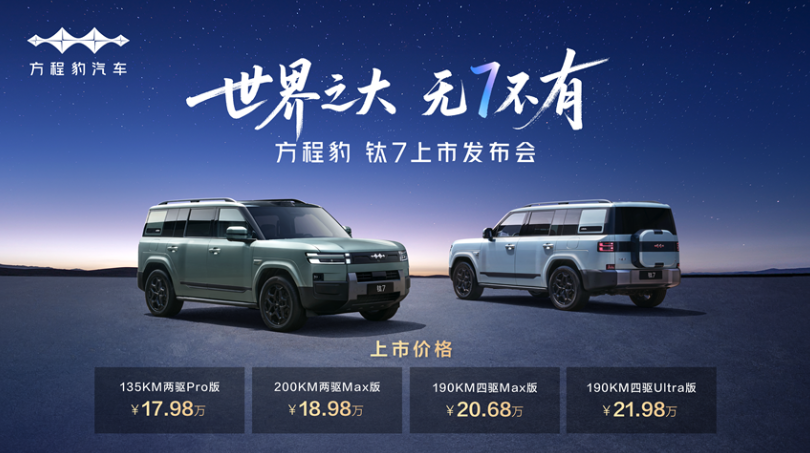
The TAI 7 is positioned for China’s upper mid-size SUV market, blending rugged styling with family comfort. Its design combines a unibody platform with the look of a traditional off-road SUV. Features include a squared-off profile, double-layer headlights shaped in twin “L” patterns, and unpainted bumpers and side skirts that emphasize durability.
A unique rear element is the external “backpack,” a compact storage box offering 32.5 liters of extra space, distinguishing it from conventional spare tire mounts. The SUV measures 4,999 mm in length, 1,995 mm in width, and 1,865 mm in height, with a 2,920 mm wheelbase. Customers can choose from seven exterior colors.

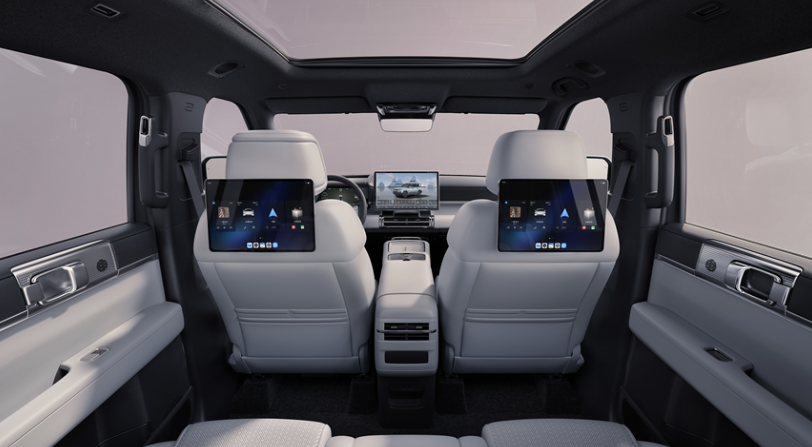
Inside, the TAI 7 features a dual-layer floating dashboard with open storage beneath the center console. It comes equipped with a 12.3-inch instrument cluster and a 15.6-inch central display, alongside a column-mounted shifter. Standard amenities include heated and ventilated seats, electric adjustment for the front row, a head-up display, and dual wireless charging pads. Higher trims add a refrigerator, a 20-speaker premium sound system, and a fragrance diffuser.
The model is promoted as a “tech-driven spacious SUV,” with an interior efficiency ratio of 70.9%. Its boxy design enables nearly 1.1 meters of headroom in both seating rows, while cargo space extends from 970 liters to 1,880 liters when the second row is folded down.
Driver-assist technologies vary by trim. The all-wheel-drive Ultra version includes the DiPilot 300 system, which integrates LiDAR and NVIDIA’s Orin-X chip. This system supports advanced NOA driving functions for highways and urban areas, as well as full-scenario parking assistance. It also offers an optional in-car drone system. Other trims feature the DiPilot 100 system with triple cameras, supporting highway NOA and planned city navigation updates via OTA.
At the core of the TAI 7 is BYD’s new-generation DM plug-in hybrid system, paired with a 1.5T engine. The two-wheel-drive model is equipped with a single 200 kW motor, while the all-wheel-drive version combines a 160 kW front motor with a 200 kW rear motor, achieving 0–100 km/h acceleration in 4.5 seconds. Battery options of 26.6 kWh and 35.6 kWh enable pure electric ranges of 135 km to 200 km, supported by a 60-liter fuel tank for extended travel
.
The SUV employs a double-wishbone front and multi-link rear suspension setup. Premium trims include BYD’s DiSus-C intelligent damping system, which features road preview and anti-motion sickness functions. Tire blowout stability control is standard across the lineup, ensuring safe stopping from speeds up to 140 km/h.