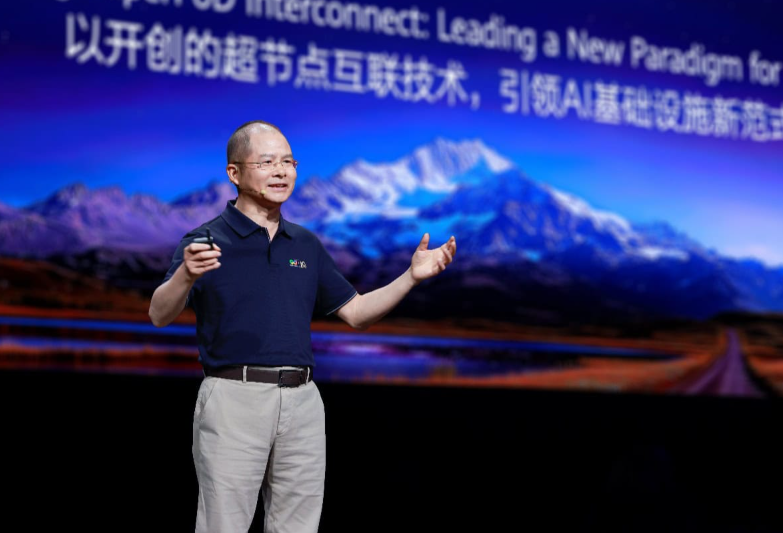
Eric Xu, Huawei's Deputy Chairman of the Board and Rotating Chairman
Xu emphasized the importance of computing power in driving AI development, noting: “Computing power is – and will continue to be – key to AI. This is especially true in China.” He explained that Huawei is working to sustainably meet long-term demand by building SuperPoDs and SuperClusters with manufacturing process nodes available on the Chinese mainland. Xu also said that rising AI demand has triggered a structural change in computing architecture, which Huawei is addressing with its latest generation of Ascend chips.
The newly launched Atlas 950 SuperPoD, equipped with 8,192 Ascend NPUs, and the Atlas 960 SuperPoD, featuring 15,488 NPUs, were highlighted as industry-leading in several categories, including total computing power, interconnect bandwidth, and memory capacity. Xu said the Atlas 950 offers 56.8 times more NPUs than NVIDIA’s NVL144 and 6.7 times greater compute. He added that even compared with NVIDIA’s upcoming NVL576, Huawei will lead across all metrics.
Huawei also announced two large-scale clusters: the Atlas 950 SuperCluster, with more than 500,000 NPUs, and the Atlas 960 SuperCluster, with over one million NPUs. The Atlas 960 SuperCluster can reach up to 4 ZFLOPS in FP4 performance, targeting the trillion-parameter model era. Xu confirmed Huawei’s roadmap of releasing a new Ascend chip annually, doubling compute capacity with each generation.
Alongside these systems, Xu unveiled the TaiShan 950 SuperPoD, the world’s first general-purpose computing SuperPoD. Combined with Huawei’s distributed GaussDB, it can serve as an alternative to mainframes, mid-range computers, and Exadata database servers. Xu said the TaiShan 950 also supports Spark workloads and virtualization, providing up to 30% faster real-time data processing and 20% higher memory efficiency.
Addressing connectivity challenges in AI infrastructure, Xu introduced UnifiedBus, Huawei’s proprietary interconnect protocol. He announced UnifiedBus 2.0, designed to enhance collaboration with industry partners and foster an open ecosystem. Xu stated: “UnifiedBus enables over 10,000 NPUs to work like one machine. It delivers 2.1-microsecond latency, 100 times the reliability of traditional optical interconnects, and more than 200 meters of range.”
He concluded by affirming Huawei’s long-term commitment: “SuperPoDs and SuperClusters powered by UnifiedBus are our answer to surging demand for computing, both today and tomorrow. Our goal is to keep pushing advancements in AI to create greater value.” Xu closed with a pledge to continue evolving Ascend chips, increasing bandwidth, enhancing usability, and supporting more data formats to meet future needs for intelligent and general-purpose computing.