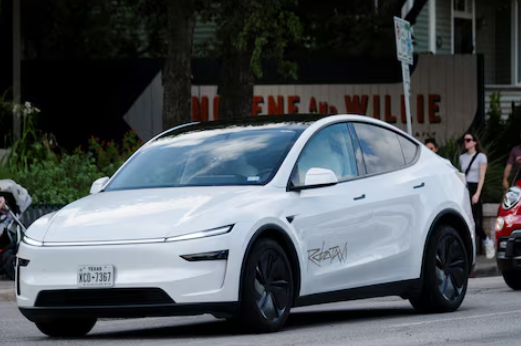
A Tesla robotaxi drives on the street along South Congress Avenue in Austin, Texas, U.S., June 22, 2025.
The Arizona Department of Transportation confirmed that Tesla is authorized to carry out these trials but did not provide details on when they would begin or how long they would last. Tesla did not respond to Reuters’ request for comment on the development.
Tesla Chief Executive Elon Musk has previously outlined the company’s plan to introduce an autonomous ride-hailing service covering about half of the U.S. population by the end of this year. The Arizona approval marks a step forward in Tesla’s effort to expand its presence in the autonomous vehicle sector.
Earlier this year, Tesla launched a small-scale trial of its robotaxi service in Austin, Texas. That pilot involved around a dozen vehicles, a limited group of passengers, and several restrictions, including the requirement for a safety monitor seated in the front passenger position.
The Arizona initiative reflects Tesla’s ongoing work to expand testing of its autonomous technology in preparation for broader deployment. By focusing on large urban areas such as Phoenix, the company aims to gather more operational data and refine its systems for future commercial rollout.
While Arizona authorities confirmed the approval, no timeline has been provided for the trial phase. The presence of safety drivers underscores the cautious approach being taken in these early tests.
Tesla’s progress in Arizona follows its gradual scaling of autonomous vehicle trials across select U.S. locations. The company’s strategy emphasizes combining limited pilot programs with plans for wider introduction once regulatory conditions and technical performance align.
With Arizona now included among its testing grounds, Tesla continues to build toward its long-term goal of establishing a networked robotaxi service. The approval provides the company with an opportunity to evaluate performance in real-world conditions and gather insights that may inform broader operations.
The upcoming tests in Phoenix are expected to serve as a critical step in the development of Tesla’s autonomous ride-hailing service, advancing the company’s goal of offering expanded mobility options through driverless technology supported by safety monitoring.