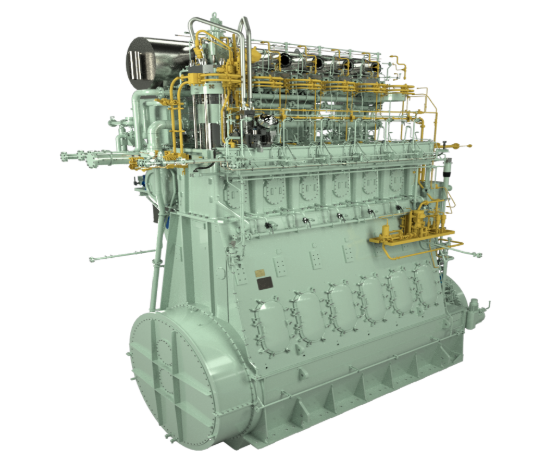
In a company statement, Everllence said: “The successful operation on ethanol means Everllence now has a fully operational engine with which to document ethanol capabilities.” The achievement positions the company to further explore ethanol as a viable fuel option for the maritime sector.
Ole Pyndt Hansen, Senior Vice President and Head of Two-Stroke R&D at Everllence, explained: “The past few years have brought steadily growing interest in ethanol from the market. We always do our utmost to listen to these signals and have accordingly been carrying out the necessary design considerations for quite some time; this has provided us with a solid technical foundation. With this latest development, we now have the technical know-how from an actual running engine to take us to the next level. Our data confirms our earlier assumption that we could run our ME-LGIM engine on ethanol without issues.”
Bjarne Foldager, Head of Two-Stroke Business at Everllence, highlighted the importance of supportive regulatory frameworks, saying the maritime industry needs legislation that considers ethanol as a viable fuel option alongside the creation of market demand.
Michael Petersen, Senior Vice President and Head of PrimeServ Denmark at Everllence, emphasized the potential for retrofitting: “The successful conclusion of running in Japan means that we are now significantly closer to offering ethanol as retrofit product, especially on the S90 engines already equipped with ME-LGIM engine technology, just as our successful ME-GI, ME-LGIP and ME-LGIM retrofit offerings. As such we are eagerly awaiting further market input with regard to the viability of ethanol from commercial, application and bunkering perspectives. In general, introducing ethanol capability to retrofitted engines will bring those customers of ours wishing to pursue alcohol-burning engines – as their pathway to IMO-defined net-zero – to a similar technology-readiness and capability as those directly adopting from our existing engine portfolio.”
This milestone coincides with the recent launch of the Global Ethanol Association (GEA), an international non-profit based in Switzerland. The GEA’s first program targets the marine fuel sector, aiming to unite resources, foster cross-sector collaboration, and expand opportunities in emerging ethanol applications. Its mission is to support sustainability, encourage innovation, and strengthen growth in established ethanol markets worldwide.
Everllence’s progress and the formation of the GEA highlight growing momentum behind ethanol as a marine fuel, reinforcing its potential role in advancing the industry toward cleaner energy solutions.