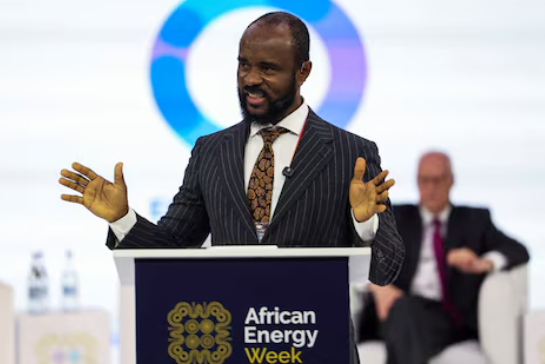
Equatorial Guinea's Minister of Mines and Hydrocarbon Antonio Oburu Ondo speaks at the African Energy Week in Cape Town, South Africa, September 29, 2025.
“This ronda (licensing round) will be launched in the second quarter of 2026 right after the details of timelines, application procedures and further information will be available,” he told an African energy conference in Cape Town.
According to officials, the licensing round will run from April to November and will offer 24 blocks, including two onshore and the rest offshore. The country, a member of the Organization of the Petroleum Exporting Countries, currently has six producing fields operated by companies such as Chevron, Trident Energy, ConocoPhillips, and state-owned GEPetrol.
OPEC’s 2024 statistical review shows that Equatorial Guinea reached peak oil production of 241,000 barrels per day in 2010. Output has since dropped to 55,000 bpd in 2023. The International Monetary Fund stated in an August report that economic growth is projected to average 0.9% per year over 2025-2030, constrained by declining hydrocarbon output.
On Monday, Chevron announced that its subsidiary Noble Energy had reached an agreement with the government on the development of the Aseng gas project in Block I of the Douala Basin. The project is expected to support liquefied natural gas supply to global markets. It will require an initial investment of about $690 million and contribute to Equatorial Guinea’s plan to position itself as a regional gas-processing hub, according to government statements.
In pursuit of this goal, Equatorial Guinea agreed last year with Nigeria to build the Gulf of Guinea Gas Pipeline. It is also working to advance the EG-27 LNG project, valued at $4.5 billion, with financing support from Afreximbank.
Afreximbank indicated that the EG-27 project, based on the Ebano field, has the potential to produce 2.4 million metric tons of LNG annually for a 20-year period.
Equatorial Guinea’s initiatives highlight its strategy to attract investment in new oil and gas exploration while also expanding natural gas infrastructure to strengthen its role in regional and global energy markets.