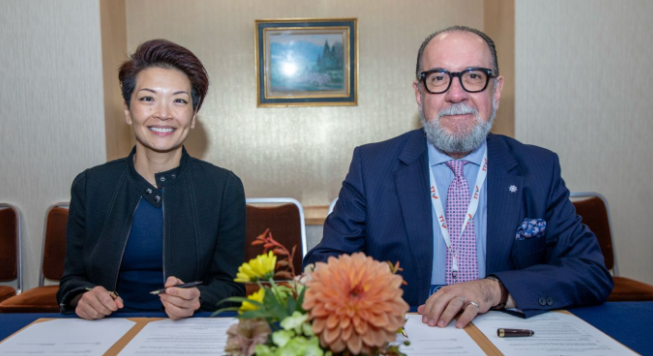
The collaboration aims to combine GCMD’s expertise in addressing operational, safety, and technical gaps across the maritime transport value chain with IAPH’s Clean Marine Fuels and Port Readiness Working Groups. IAPH represents a global port network of more than 200 port authorities and operators, providing a platform to advance sustainable practices across the sector.
Officials from GCMD highlighted that the partnership will focus on enhancing the maritime industry’s preparedness for the transition to alternative fuels. This includes tackling challenges and identifying opportunities in alternative fuel bunkering, port infrastructure development, and regulatory framework support.
The partnership builds on the organizations’ previous collaboration. GCMD has supported the Clean Energy Marine Hubs (CEM-HUBS) initiative, a cross-sector public-private platform led by maritime stakeholders and energy ministers under the Clean Energy Ministerial (CEM). Launched to unify efforts across energy and transport ministries, CEM-HUBS works to de-risk the use and transport of low-carbon fuels in shipping. GCMD has participated in this initiative since 2023.
Through its Clean Marine Fuels Working Group, IAPH has developed tools for ports and maritime transport companies to facilitate safe bunkering operations for current and emerging clean fuels. Under the new partnership, GCMD and IAPH plan to enhance GCMD’s existing tools and co-create new resources to assist ports, shipowners, and operators in adopting alternative bunkering fuels and transporting low- and zero-carbon fuels as cargo.
GCMD has also conducted pilot projects across the maritime value chain, developing risk-mitigation strategies for new fuels and establishing operating procedures for activities such as ammonia bunkering and liquid carbon dioxide (LCO2) offloading. These pilots aim to close knowledge gaps and create globally applicable practices, adapted to port-specific conditions.
Lynn Loo, CEO of GCMD, emphasized the critical role ports have played in these initiatives: “In nearly all of GCMD’s pilots, ports have been pivotal to our success—whether in enabling the world’s first ship-to-ship ammonia transfer at the Pilbara, bunkering across six biofuel supply chains in Singapore or the Port of Rotterdam, or demonstrating the full value chain for onboard captured CO2 in China.”
Loo added that the partnership with IAPH is intended to translate pilot project learnings into “scalable operations essential for the energy transition,” reinforcing the combined goal of advancing maritime decarbonization globally.
The agreement represents a strategic step toward integrating alternative fuels and sustainable practices into maritime and port operations, supporting the wider transition to low- and zero-carbon shipping while promoting safety, efficiency, and regulatory alignment across the industry.