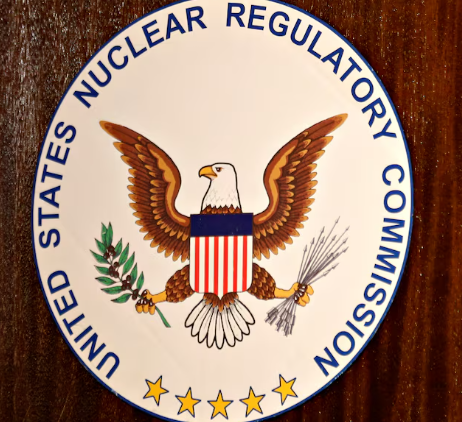
The logo of the U.S. Nuclear Regulatory Commission is shown on the podium during a public meeting hosted by the U.S. Nuclear Regulatory Commission to discuss issues surrounding the decommissioning of the reactors at the San Onofre Nuclear Generating Station in Carlsbad, California September 26, 2013.
The project, known as HI-STORE, was planned near Carlsbad in the oil and gas-rich Permian Basin. However, strong opposition from New Mexico state officials has continued. Governor Michelle Lujan Grisham and other lawmakers have resisted the idea of storing nuclear waste in the state, even temporarily, expressing concern that without a permanent national repository, the storage site could become a long-term solution.
Holtec stated on Wednesday that it was discontinuing the HI-STORE project due to the lack of a viable path forward. “Due to the untenable path forward for used fuel storage in New Mexico, we mutually agreed upon cancelling the agreement,” the company said in a statement, referring to its partnership with the Eddy-Lea Energy Alliance. The announcement was first reported by Axios.
Don Hancock, director of the nuclear waste safety program at the Southwest Research and Information Center in Albuquerque, said: “It’s been clear for years that most New Mexicans oppose spent fuel storage and disposal in the state. We’re glad that Holtec has finally recognized that reality.”
Holtec spokesperson Pat O’Brien said the company plans to engage with other states that may be more receptive to nuclear waste storage. He noted that this outreach aligns with efforts by the U.S. Department of Energy, which began during the administration of former President Joe Biden, to identify willing host communities. O’Brien added that Holtec expects about 15 to 20 states may consider moving forward with potential storage facilities.
Nuclear waste poses long-term environmental and health risks and must be stored safely for thousands of years. Currently, such waste is kept at nuclear power stations across the United States, both active and decommissioned. The U.S. government previously spent billions of dollars developing a permanent disposal site at Yucca Mountain, Nevada, but that project was halted in 2010 after opposition from state officials and a funding cutoff under former President Barack Obama’s administration.
In a separate development, Danish renewable energy firm Ørsted announced plans to cut about 2,000 jobs globally by the end of 2027 as it refocuses its business on European markets following recent project setbacks.