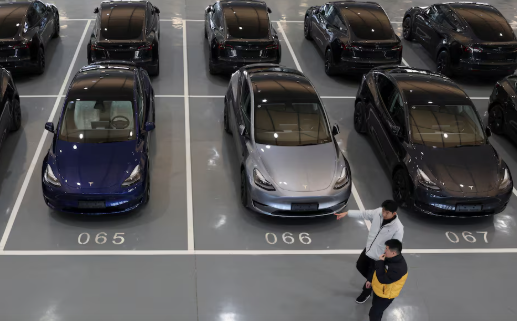
People walk past Tesla electric vehicles (EV) at the carmaker's delivery centre in Beijing, China January 8, 2025.
The September figures also followed reports of a partial recovery in Tesla’s European sales. Vehicles produced at Tesla’s Shanghai Gigafactory, including exports to Europe and other regions, climbed 9.2% month-on-month from August. In addition, the company began first deliveries of Chinese-made EVs to India during the same period, expanding its export footprint in Asia.
In the third quarter, Tesla delivered 241,890 Chinese-made EVs, ranking as its fourth-highest quarterly total on record. The strong performance in China contributed to Tesla’s record global quarterly deliveries, which exceeded analysts’ expectations. The global uptick was partly driven by a surge in demand before the expiration of the U.S. EV tax credit at the end of September.
Tesla has recently introduced affordable versions of its Model Y and Model 3, reinforcing its strategy to broaden accessibility to its lineup. Deliveries for these versions are expected to begin between December and January across several markets, although the company has not yet announced a timeline for their launch in China.
Meanwhile, BYD, Tesla’s top Chinese competitor, reported its first decline in quarterly car sales since 2020, suggesting a possible slowdown after years of rapid expansion. The development highlights increasing competition and changing dynamics within the world’s largest electric vehicle market.
In response to intensifying market pressures, Tesla unveiled the six-seat Model Y L in August, a long-wheelbase variant of its best-selling SUV, designed to meet the preferences of Chinese consumers who favor larger family-oriented vehicles. Deliveries of this model started in September, aligning with the recovery in monthly sales.
Industry analysts note that Tesla’s renewed momentum in China and Europe reflects its flexible production and export strategy, centered on the Shanghai plant, which serves as a major global supply hub. The plant’s output supports not only domestic consumption but also exports to regions such as Europe, the Middle East, and Asia-Pacific.
Tesla’s sustained growth in production and global deliveries underscores its effort to balance supply across multiple markets while managing rising competition and shifting consumer preferences. As China remains a cornerstone of its manufacturing and sales operations, the company’s localized innovation and product diversification are expected to play a key role in maintaining its competitiveness in the expanding EV market.