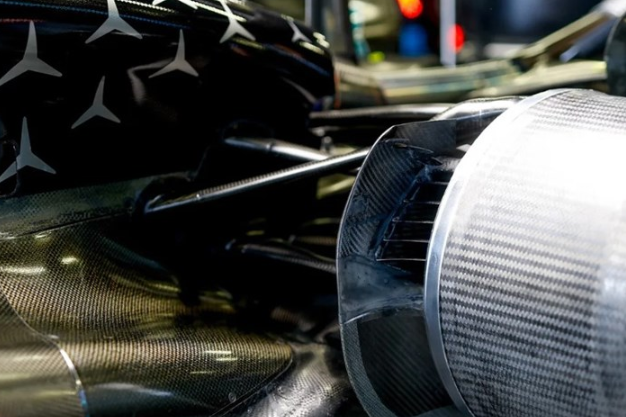
This marked the first time the team applied bio-based carbon fiber composites on a technically critical component in race conditions. The rear brake duct wheel shields, featuring intricate aerodynamic surfaces, demonstrated that the material can withstand the extreme mechanical and thermal stresses of Formula One racing, highlighting its potential for broader adoption in the sport.
Alice Ashpitel, head of sustainability at Mercedes-AMG Petronas, commented: “This project with Syensqo [Brussels, Belgium and Alpharetta, Ga., U.S.] highlights our commitment to reduce our environmental impact while maintaining the highest standards of performance. The fact that these materials have been derived from byproducts associated with the creation of bio-diesel is an added benefit and indicates the power of advanced sustainable fuels.”
The material development was supported by Syensqo’s bio-based resin technology. Rodrigo Elizondo, president of Syensqo Composite Materials, noted: “By replacing traditional petroleum-based components with those derived from renewable sources, we are not only introducing circularity in our product design but also paving the way for future innovations.”
The W16 project demonstrates a practical application of sustainable materials in high-performance motorsport, showing that environmentally friendly composites can meet stringent requirements for strength, durability, and aerodynamic efficiency. The successful integration of bio-based resins into key components illustrates a path for other teams and industries seeking to reduce reliance on petroleum-based materials while maintaining technical performance.
The development aligns with Formula One’s broader push toward sustainability, emphasizing material circularity, reduced carbon footprint, and innovative design approaches. Using byproducts from bio-diesel production in composite manufacturing also underscores the potential for synergy between sustainable fuels and high-performance materials, creating a closed-loop system that reduces waste and enhances resource efficiency.
The Mercedes-AMG Petronas initiative highlights the feasibility of adopting renewable-source composites in elite motorsport and sets a benchmark for future technical innovations. With bio-based materials proving capable in demanding race conditions, there is significant potential for expansion into other vehicle components, automotive industries, and high-performance engineering applications.
The project demonstrates that performance, safety, and sustainability can coexist, reinforcing the role of advanced materials research in accelerating the adoption of environmentally responsible technologies across Formula One and beyond. The collaboration between Mercedes-AMG Petronas and Syensqo showcases how motorsport can act as a testbed for scalable sustainable solutions, paving the way for a greener future in high-performance engineering.