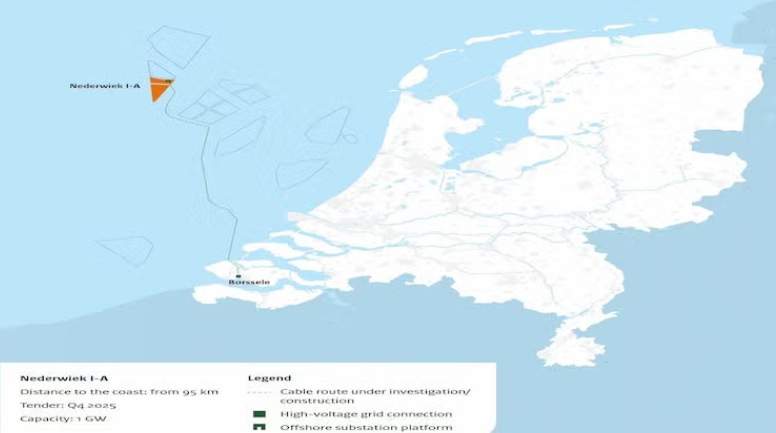
The location of the Nederwiek I-a site.
According to the government announcement, grid operator TenneT will be responsible for connecting the wind farm to the national electricity grid. The project will use an offshore substation platform equipped with a 2GW direct current connection linking to an onshore substation in Borssele. This infrastructure will also serve the neighboring Nederwiek I-B wind farm, forming part of a broader grid integration plan to enhance power transmission efficiency.
The permit application process evaluates participants based on several key factors, including the project’s feasibility, its contribution to the country’s renewable energy targets, the financial offer, and the effectiveness of environmental protection measures. A significant focus of the assessment is on minimizing ecological impact and supporting marine biodiversity, reflecting the government’s commitment to sustainable development in the North Sea.
As part of its policy to foster competition and reduce investment risks, the Dutch government has adjusted the project parameters for this round of bidding. The site size has been reduced to 1GW, and the tender rules have been modified to include more flexible participation criteria and revised liability terms. These adjustments are designed to attract a wider range of bidders and accelerate the overall project schedule.
Construction of the Nederwiek I-A wind farm is expected to begin in 2030. The government plans to announce the successful bidder in the spring of 2026, giving the selected developer sufficient time to prepare financing, design, and environmental compliance plans. Once operational, the wind farm will contribute substantially to the Netherlands’ renewable power supply and help advance its national climate objectives.
The Nederwiek I-A project forms part of the Netherlands’ long-term strategy to expand offshore wind generation in the North Sea, a key area for the country’s clean energy transition. By increasing installed wind capacity, the government aims to strengthen energy security, reduce carbon emissions, and promote economic growth through investment in sustainable infrastructure.
With the new tender, the Netherlands continues to demonstrate its commitment to achieving climate neutrality while maintaining a balance between technological development, environmental protection, and energy market competitiveness.