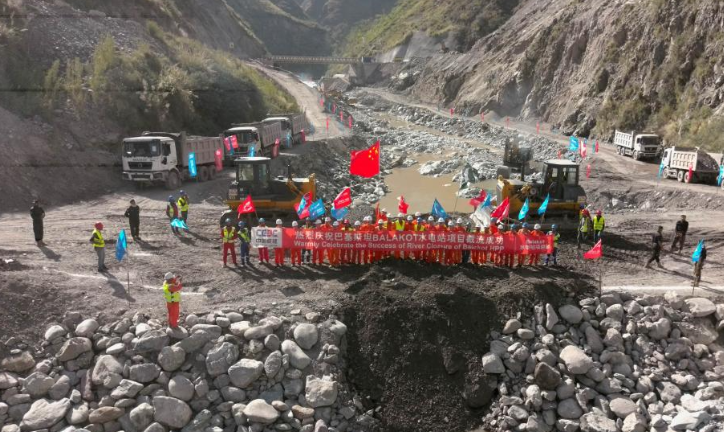
Workers celebrate at a river closure ceremony of the Balakot Hydropower Project in the northwest Khyber Pakhtunkhwa (KP) province of Pakistan, Oct. 25, 2025.
At the ceremony, Syed Habib Ullah Shah, chief executive officer of the Pakhtunkhwa Energy Development Organization and the person-in-charge representing the project owner, stated that the Balakot Hydropower Project is currently the largest hydropower development under construction in KP. He said the project, once completed, will help address Pakistan’s growing electricity demand, support economic growth, and contribute to efforts in climate change mitigation. He also noted that it will advance Pakistan’s green and low-carbon energy transition.
Shah emphasized that the hydropower station will play an important role in reducing Pakistan’s dependence on imported energy and enhancing the country’s energy security and economic resilience. The project is expected to become a sustainable power source supporting both local development and broader regional energy needs.
Mao Huigang, general manager of China Gezhouba Group Third Engineering Co., Ltd., highlighted that the construction has already created more than 2,000 local jobs and has driven the growth of related industries such as construction materials, power supply, and services. Mao said: “We will continue to strengthen cooperation with our Pakistani partners in the fields of energy, power, and water resources, and make every effort to advance the main dam construction. Our goal is to build this project into a model of China-Pakistan energy cooperation.”
The Balakot Hydropower Project is designed to generate an average of 1.144 billion kilowatt-hours of electricity annually after completion, which will be sufficient to meet the power needs of approximately 1.8 million people. The project is also expected to provide stable, clean, and affordable energy, contributing to Pakistan’s efforts to expand renewable energy generation and reduce carbon emissions.
The hydropower development is part of ongoing cooperation between China and Pakistan in energy and infrastructure construction. Through such projects, both sides aim to enhance local industrial capacity, create employment opportunities, and promote sustainable economic growth. The successful river closure marks significant progress toward achieving these shared goals and lays a solid foundation for the next stage of construction, moving the project closer to full operation.