Baker Hughes’ technology solutions will support the plant in producing blue ammonia via an autothermal reforming (ATR) process, coupled with an integrated carbon capture and storage (CCS) system capable of sequestering up to 2.3 million metric tons of CO? per year. The company’s scope includes multiple compressors, covering ammonia, syngas, recycle, and CO? compression, to deliver captured CO? to geological storage through a pipeline. It also includes a steam turbine-driven BRUSH™ Power Generation generator.
Ammonia is increasingly recognized as a low-carbon energy source, with growing importance in decarbonizing sectors such as agriculture, power generation, and marine applications. Baker Hughes provides integrated solutions that meet the complex technical requirements of large-scale projects like Blue Point.
Alessandro Bresciani, senior vice president of Energy Equipment at Baker Hughes, said: “Ammonia, as a lower-carbon energy source, is poised to play a pivotal role in enabling and accelerating global sustainable energy development. As ammonia expands from agricultural and chemical use to a global commodity for energy, we are proud to support the scaling of it with our proven technology solutions for one of the world’s largest low-carbon ammonia projects.”
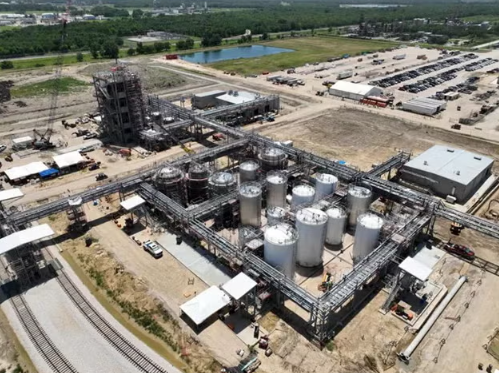
The ATR ammonia facility will be built at CF Industries’ Blue Point Complex in Louisiana. The project plans to permanently store up to 2.3 million metric tons of CO? annually in a Class VI well.
Construction is expected to begin in 2026, with low-carbon ammonia production projected for 2029. Baker Hughes’ involvement highlights the role of advanced compression and power generation technology in enabling large-scale, low-carbon ammonia production.
The Blue Point Number One Ammonia Project represents a significant step in expanding ammonia as a sustainable energy source and demonstrates the integration of advanced technologies to achieve substantial carbon reduction. With its comprehensive solutions, Baker Hughes aims to support both the operational efficiency of the plant and the global transition toward lower-carbon energy.
This project underscores ammonia’s emerging role beyond traditional agricultural and chemical uses, positioning it as a key contributor to global decarbonization efforts while leveraging advanced industrial technology to achieve high environmental performance.