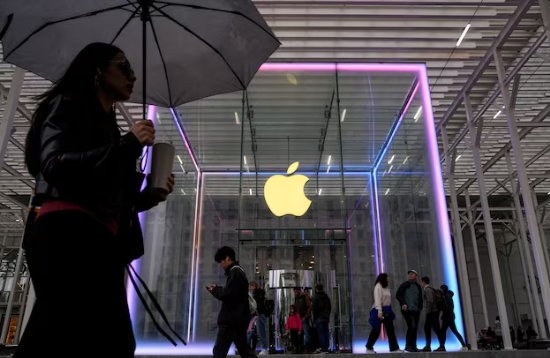
People walk past the Apple Fifth Avenue store in New York City, U.S., May 23, 2025.
Although supply constraints affected Apple’s fourth-quarter sales, the successful September launch of the iPhone 17 series helped push the company’s market capitalization above $4 trillion earlier this week, joining Nvidia and Microsoft in the elite group of trillion-dollar technology giants. Analysts said the rebound reflected robust consumer interest in Apple’s latest devices and expectations of strong holiday sales.
The company’s forward guidance has also eased investor concerns over its pace in integrating artificial intelligence capabilities. While competitors such as Microsoft, Google, and Amazon have made rapid advances in AI, Apple has focused on developing the technology carefully for future product applications. “I just know that owning this stock for many decades ... When you're really big like Apple, you don't have to move fast, sometimes you just have to get it right eventually,” said Eric Clark, chief investment officer at Accuvest.
Despite the recent share gain, Apple and Amazon remain the weakest performers so far this year among the “Magnificent Seven” group of large-cap U.S. technology companies. However, Amazon’s stock also climbed sharply before the market opened on Friday, buoyed by stronger-than-expected results in its cloud computing division during the latest quarter.
Market data from LSEG showed that Apple’s shares currently trade at 33.4 times analysts’ projected earnings, higher than Microsoft’s 31.7 and Meta Platforms’ 22.3. The elevated valuation suggests investors are still willing to pay a premium for Apple’s long-term growth potential, brand strength, and steady profitability.
Apple’s recent milestone—surpassing $4 trillion in market capitalization—marks another major achievement for the company, underscoring its continued influence in the global technology sector. Alongside Nvidia and Microsoft, Apple remains at the forefront of innovation and market leadership among the world’s most valuable firms.
Analysts noted that the upcoming holiday season will be a critical period for Apple, as consumer demand for its flagship devices, including the iPhone 17 and other new products, will shape near-term financial results. The company’s ability to manage supply chain challenges and meet rising demand in major markets such as the United States and China will be closely monitored by investors.
Overall, Apple’s latest performance and forward-looking guidance have strengthened market confidence in its growth outlook, suggesting that the company is well positioned to sustain momentum into 2025 despite global economic uncertainties and ongoing competition in the technology sector.