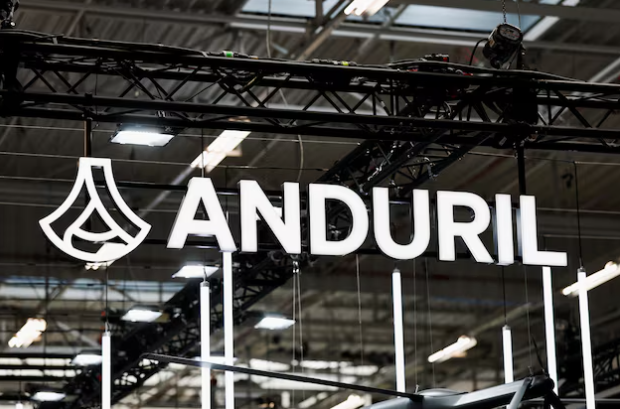
An Anduril Industries logo is seen at the 55th International Paris Airshow at Le Bourget Airport near Paris, France, June 17, 2025.
According to the Air Force, the flight represents a significant advance in its broader plan to deploy a fleet of autonomous, jet-powered drones capable of operating alongside manned aircraft. The initiative is part of ongoing efforts by the Pentagon to develop future combat systems that integrate artificial intelligence and autonomous operations. Troy Meink, Secretary of the Air Force, said in a statement: “This milestone demonstrates how competition drives innovation and accelerates delivery.”
The new drone, designated YFQ-44A, resembles a compact fighter jet without windows and flew “semi-autonomously,” according to Jason Levin, Anduril’s engineering lead. Levin stated that the aircraft was able to control its flight surfaces and adjust throttle power independently, with minimal human input. “There is no operator with a stick and throttle flying the aircraft behind the scenes,” Levin said, adding that the drone could perform automated landings “at the push of a button.”
The demonstration follows Anduril’s April 2024 contract award, in which the Air Force selected both Anduril and General Atomics to develop prototype “loyal wingman” drones with advanced autonomous flight capabilities. During the summer, General Atomics reported that it had completed the first flight of its own Collaborative Combat Aircraft (CCA) prototype, the YFQ-42A, which also demonstrated semi-autonomous operation.
The Air Force is expected to issue another contract soon for the second phase of the CCA program and is reviewing proposals from approximately 20 companies, according to defense industry sources. Meanwhile, another emerging developer, Shield AI, recently announced work on its own autonomous aircraft called the X-BAT, further intensifying competition in this rapidly advancing sector.
Anduril said it intends to increase production efforts for its drone program, with manufacturing of the YFQ-44A prototype scheduled to begin next year at a new facility in Ohio. The company’s progress aligns with the U.S. Air Force’s goal to integrate more cost-effective, adaptable, and unmanned systems into future air operations.
The successful flight demonstrates a key technical achievement for Anduril, which has been expanding its presence in the defense technology industry through projects involving autonomous aircraft, surveillance systems, and artificial intelligence. The company said the YFQ-44A will undergo additional testing before full-scale production begins.
On the same day, Wall Street’s major indexes closed slightly higher, with the Dow posting a modest gain, reflecting positive investor sentiment following broader technological and defense industry developments.