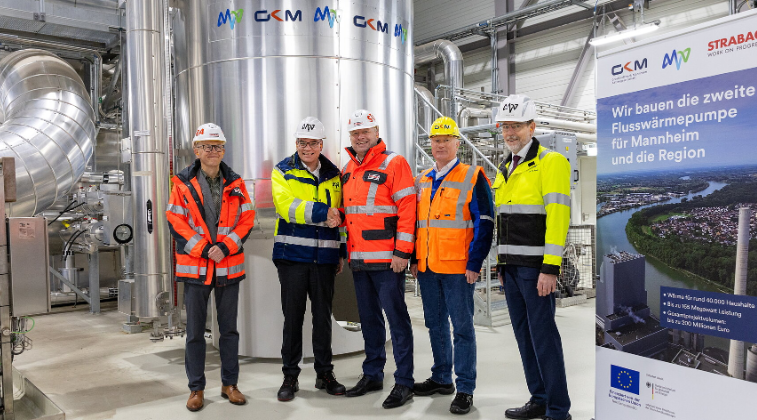
Left to right: Managing Director of Strabag Umwelttechnik Thomas Büchner, MVV chief executive Dr. Gabriël Clemens, Strabag Austria’s head of energy infrastructure Christian Sadleder, GKM chief technology officer Thomas Hörtinger and MVV chief technology officer Dr. Hansjörg Roll
The large-scale heat pump will include two separate modules, each delivering an output of 82.5MW. Strabag Umwelttechnik collaborated with German engineering company INP on the system design, while Atlas Copco will supply the turbo compressors. Once operational, the installation will generate enough heat to supply around 40,000 households in the region.
The system will draw thermal energy from the Rhine River, using its water as a heat source. By employing the natural refrigerant isobutane, it will produce district heating at temperatures of up to 130°C. This installation marks Strabag’s second heat pump project at the Grosskraftwerk Mannheim AG (GKM) site, reinforcing the company’s involvement in large-scale renewable heat infrastructure.
The project forms part of a broader initiative to develop efficient heating networks, supported by €200 million in funding from the European Union. The funding aims to accelerate the deployment of sustainable energy systems and reduce reliance on conventional heating methods. Construction of the heat pump and related infrastructure is expected to begin in 2026.
In addition to the heat pump, MVV plans to construct a hydrogen-ready district heating post-heater at the same GKM location. This unit will operate during specific periods to raise water temperatures to required network levels, improving system flexibility and seasonal efficiency. The integration of hydrogen technology also allows for potential future adaptation as cleaner fuels become more widely available.
MVV’s Chief Technology Officer, Dr. Hansjörg Roll, said: “Thanks to energy from thermal waste treatment, our biomass combined heat and power plant, and the first river-source heat pump, we are already able to cover nearly 50 percent of our district heating needs from renewable sources. The new river-source heat pump is scheduled to go into operation in winter 2028, providing climate-friendly heat. To achieve full decarbonisation, we are also planning an additional river-source heat pump and the use of the region’s geothermal potential.”
The upcoming installation is expected to play a key role in MVV’s long-term sustainability goals. The combination of river-source heat, hydrogen technology, and potential geothermal resources highlights the growing integration of renewable solutions in district heating. Once completed, the system will contribute significantly to regional energy transition efforts and provide a model for future low-emission heating projects across Europe.