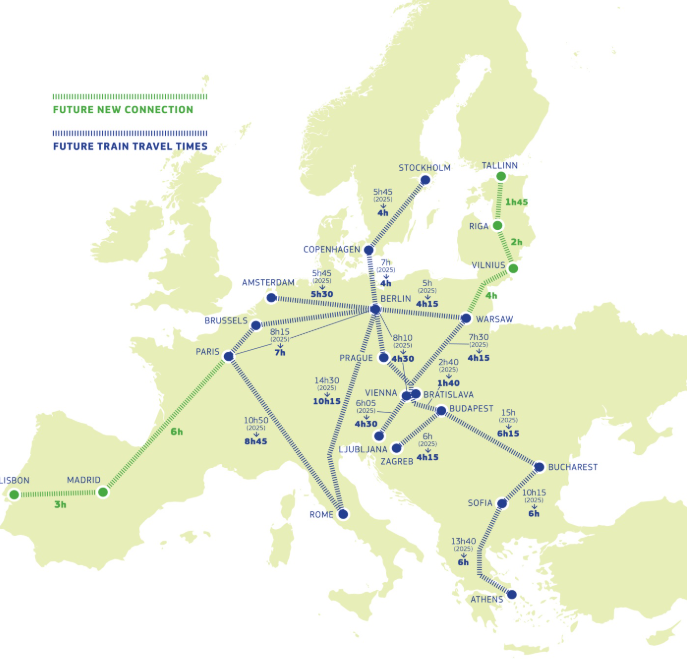
The plan foresees dramatic reductions in travel times, such as cutting the Berlin–Copenhagen journey from seven to four hours by 2030
Under the plan, travel times will be cut significantly, including reducing the Berlin–Copenhagen journey from seven to four hours by 2030 and connecting Sofia and Athens in six hours by 2035. A new high-speed corridor from Paris to Lisbon via Madrid is also planned, enhancing connectivity between Western and Southern Europe.
Apostolos Tzitzikostas, Commissioner for Sustainable Transport and Tourism, said: “High-speed rail is not just about cutting travel times – it’s about uniting Europeans, strengthening our economy, and leading the global race for sustainable transport. With today’s plan, we are turning ambition into action: breaking down barriers, mobilising investments for modern infrastructure, and making cross-border rail the backbone of a carbon-neutral, competitive, and secure Europe.”
The initiative builds on decades of EU investment in sustainable transport. So far, €34.4 billion has been channelled through the Connecting Europe Facility to support 804 rail projects across the continent. The new plan focuses on accelerating investment, harmonising fragmented systems, and removing cross-border bottlenecks by 2027 to enable higher speeds, including services exceeding 250 km/h where feasible.
The Commission will also coordinate public and private funding through a comprehensive EU financing strategy, culminating in a “High-Speed Rail Deal” – a multilateral commitment from governments, industry, and financial actors to complete the Trans-European Transport Network by 2040.
Passenger experience and market competitiveness are central to the plan. Legislation will encourage a second-hand market for rolling stock, prevent premature scrapping of safe trains, and improve cross-border ticketing and booking systems. Travelers will gain easier access to through-tickets across multiple operators and stronger protection of their rights.
Barriers for high-speed rail operators will also be reduced. Fair access to tracks and service facilities will be ensured, stimulating competition and making travel more affordable. Innovation and technical harmonisation are priorities, with a 2026 research programme under Europe’s Rail initiative supporting the development of next-generation high-speed trains capable of seamless cross-border operation.
The strategy also aims to ease congestion on existing lines, expand capacity for regional and night trains, and enhance Europe’s security by facilitating rapid movement of both civilian and military transport. Progress will be monitored via a high-speed rail scoreboard, while the European Union Agency for Railways will receive an expanded mandate in 2026 to streamline authorisations and remove redundant national rules.
Overall, the plan represents a major step in modernising Europe’s rail network, boosting connectivity, supporting sustainable transport, and positioning high-speed rail as a key pillar of a carbon-neutral and efficient European transport system.