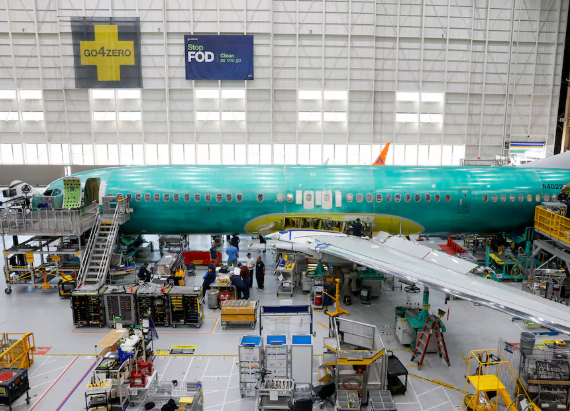
A Boeing 737 MAX aircraft is assembled at the company's plant in Renton, Washington, U.S. June 25, 2024.
The U.S. planemaker is on pace for its highest annual aircraft delivery total since 2018, when it delivered 806 jets. Deliveries dropped sharply after that year due to the grounding of the 737 MAX following two accidents and subsequent production challenges, which were further compounded by the COVID-19 pandemic. These events disrupted Boeing’s output and led to a series of quality and safety reviews.
Boeing CEO Kelly Ortberg has prioritized improving manufacturing quality across the company’s commercial airplane operations in 2025. Recently, U.S. regulators granted Boeing approval to raise its 737 production rate to 42 aircraft per month, up from 38. Despite this progress, Boeing still trails its European competitor Airbus (AIR.PA), which has delivered 585 aircraft during the first ten months of the year.
In October, Boeing’s order activity was relatively modest. The company recorded 15 new orders—eight for the 737 series and seven for the 787 Dreamliner—while also receiving cancellations for seven 737s, resulting in a net of eight new orders. For the year to date, Boeing has logged 782 new aircraft orders after accounting for cancellations and conversions.
The 787 Dreamliner continues to perform well in Boeing’s portfolio. As of October 31, the company had received 320 orders for the widebody model in 2025, making this its second-highest annual total for the aircraft after 369 orders recorded in 2007. Boeing is expanding its 787 assembly operations in South Carolina to meet rising demand.
The company’s 787 Dreamliner remains a key part of its international sales success, with two Central Asian airlines recently announcing plans to purchase additional units. Boeing’s overall order backlog now stands at 5,911 aircraft, underscoring a solid long-term production pipeline.
Boeing shares closed slightly higher at $194.81 on Monday, up 0.1%, bringing the stock’s year-to-date gain to 13.4%. Market indicators were mixed, with the S&P 500 inching up by 0.2% while the tech-heavy Nasdaq edged down by 0.25%.
Boeing’s delivery progress, coupled with new orders and regulatory approval to increase output, indicates gradual recovery momentum in its commercial jet business after several years of production setbacks and market volatility.