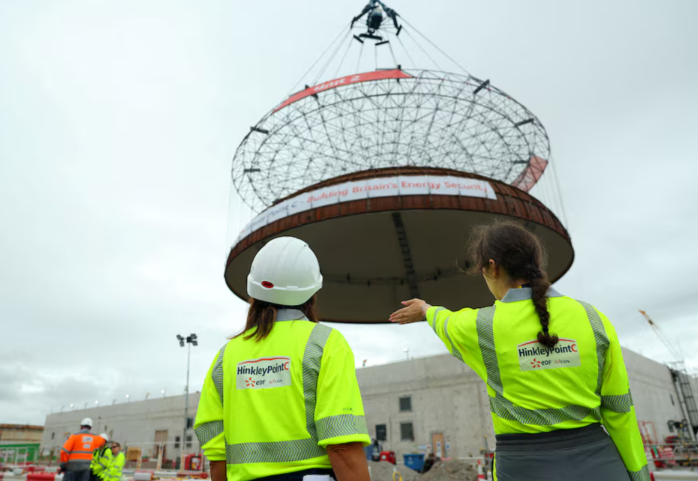
Workers stand near a 245-tonne domed roof lifted by the land crane "Big Carl" before placing on the second reactor building at the Hinkley Point C nuclear power station near Bridgwater, Britain, July 17, 2025.
In June, the British government pledged 2.5 billion pounds ($3.36 billion) to support the SMR initiative. These smaller nuclear reactors are designed to be more cost-effective and faster to construct compared to traditional large-scale plants. The chosen Wylfa site was previously home to a nuclear power station that ceased operations in 2015, making it a practical location for redevelopment within the existing infrastructure.
The U.S. ambassador to the United Kingdom issued a strongly worded statement before the announcement, expressing concern that Washington had hoped for a large-scale nuclear project at the same site. Despite the criticism, the UK government reaffirmed its commitment to the SMR program, noting that its broader nuclear strategy also includes the potential construction of a new large-scale plant. State-owned GB Energy-Nuclear has been assigned to identify a suitable site for that project by autumn 2026.
The government confirmed that the SMR design selected in June was developed by Rolls-Royce. According to official estimates, the new reactors at Wylfa will generate electricity for the equivalent of 3 million homes. The construction phase is expected to create up to 3,000 jobs in the local community, supporting regional economic growth. The reactors are planned to be connected to the national grid in the 2030s, adding an important source of low-carbon energy to the country’s power supply.
Currently, two large-scale nuclear power projects are under construction in Britain: Hinkley Point C in western England and Sizewell C in eastern England. Together with the new SMR initiative, these projects form a central part of the government’s long-term plan to diversify energy generation and reduce reliance on fossil fuels.
The Wylfa SMR project highlights the UK’s intention to combine advanced nuclear technology with economic development in local regions, creating skilled employment opportunities and contributing to the overall goal of achieving net-zero emissions by mid-century.