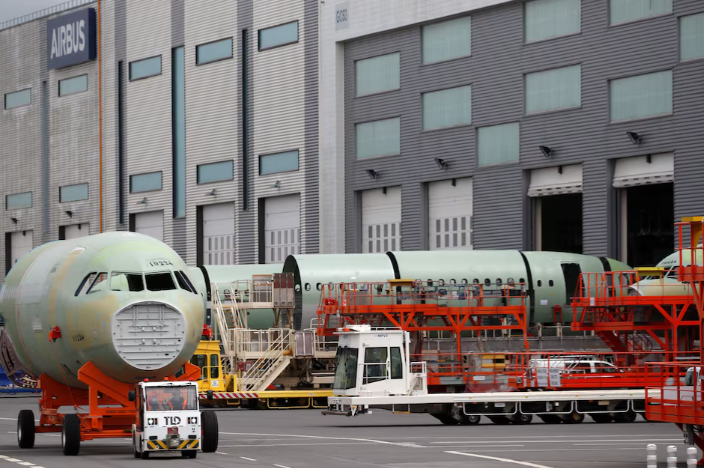
Airbus logo is seen in this illustration taken, March 10, 2025.
Grainne van den Berg, Airbus Head of Marketing for Africa and the Middle East, shared these insights during a media briefing. She indicated that passenger traffic in the area is anticipated to increase at a steady compound annual growth rate of 4.4% throughout the forecast period.
Additionally, the company estimates that the aviation services sector in the Middle East will grow to a value of $29.9 billion by the conclusion of 2044, effectively doubling from present levels, van den Berg noted.
These projections were presented in advance of the Dubai Airshow, a key aviation gathering scheduled for November 17 to 21 in the United Arab Emirates. The event serves as a platform for industry participants, including Airbus and its primary counterpart Boeing, listed as BA.N, to showcase offerings and secure new contracts.
Within the overall demand outlook, widebody aircraft are expected to account for 42% of the total fleet requirements in the Middle East by 2044. This proportion stands as the largest globally for this category of planes.
Gabriel Semelas, Airbus President for Africa and the Middle East, emphasized the region's evolving role: "The Middle East is transforming global aviation, and the forecast fleet expansion is truly significant, particularly when it comes to widebodies," he stated.
"This region is becoming the long-haul hub now and into the future," Semelas added.
The anticipated growth reflects broader trends in air travel demand, driven by economic development, population increases, and enhanced connectivity across international routes. Middle Eastern carriers have established themselves as major operators of long-distance flights, linking continents through efficient hub operations.
Airbus bases its forecasts on detailed analyses of traffic patterns, airline capacity planning, and infrastructure developments. The emphasis on widebody models aligns with the need for high-capacity aircraft suitable for extended ranges and dense passenger volumes on popular corridors.
As airports in the region continue to expand terminals and runways, they accommodate larger volumes of transfers and direct services. This infrastructure supports the projected rise in both regional and intercontinental journeys.
The services market expansion encompasses maintenance, repair, overhaul, and training activities essential for fleet operations. With more aircraft entering service, demand for these support functions rises correspondingly, creating opportunities for specialized providers.
Airbus participates actively in the Dubai Airshow to engage with airline executives, government representatives, and supply chain partners. Discussions often center on fleet modernization, fuel efficiency improvements, and sustainable aviation practices.
The company's presence at the event underscores its commitment to the Middle East market, where several leading airlines maintain substantial orders for future deliveries. These commitments contribute to the long-term fleet composition outlined in the forecast.
Overall, the projections highlight the Middle East's increasing prominence in worldwide aviation networks. By focusing on widebody acquisitions, operators position themselves to handle growing traffic flows efficiently.
Semelas' comments point to a strategic shift where the region serves as a central node for global air travel. This development benefits passengers through more route options and supports cargo movements vital for trade.
As the industry evolves, Airbus monitors key indicators such as load factors, yield management, and environmental regulations to refine its outlooks. The current forecast provides a baseline for stakeholders planning investments in aircraft and related facilities.
With the Dubai Airshow underway, further announcements regarding orders and partnerships may emerge, adding detail to the broader growth narrative. For now, the emphasis remains on preparing for a substantially larger and more capable fleet by mid-century.