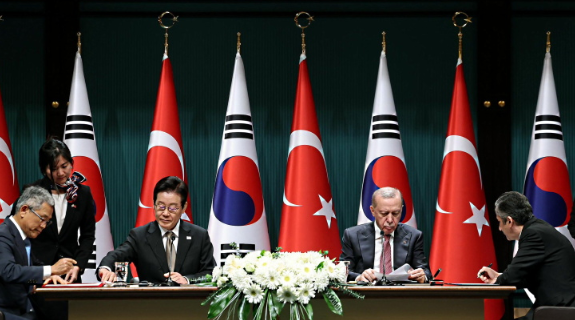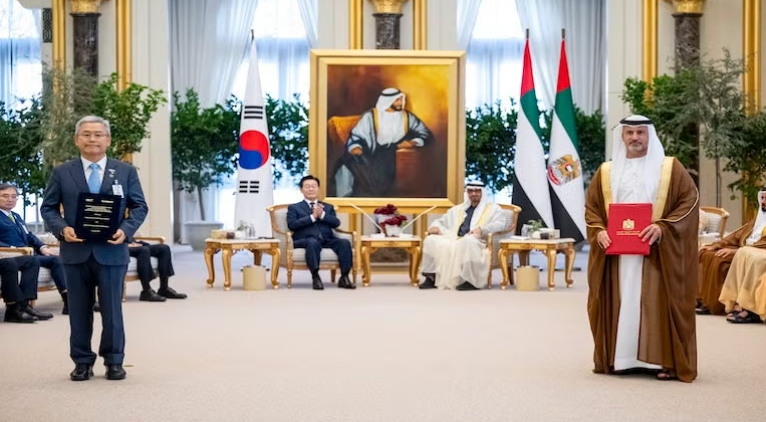
The MoU was signed during the official UAE – Korean Presidential summit by H.E. Mohamed Al Hammadi, managing director and group CEO of ENEC (right), and Kim Dong Cheol, president and CEO of KEPCO.
The agreement aims to support the continued development and operation of civil nuclear power programs in both the United Arab Emirates and the Republic of Korea. It also establishes a framework for joint participation in potential nuclear energy projects in other countries.
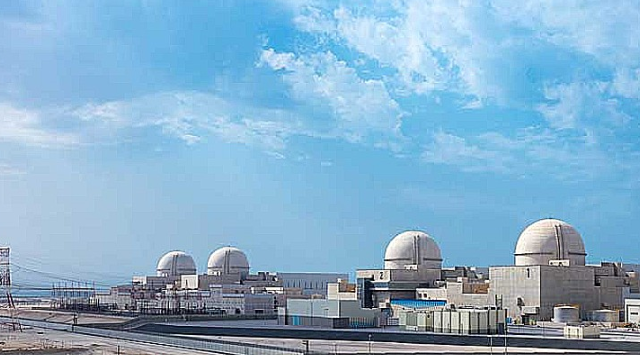
The new MoU extends the successful partnership that delivered the Barakah Nuclear Energy Plant, where KEPCO served as the main contractor. It expands cooperation across several key areas, including the evaluation of small modular reactors (SMRs), next-generation reactor designs, nuclear fuel cycle advancements, radioactive waste management solutions, and nuclear safety research.
Additionally, the partnership will focus on digital transformation and artificial intelligence applications in the nuclear sector. Specific initiatives include AI-driven predictive maintenance systems, performance optimization tools, digital twin technology, and machine learning solutions designed to improve both safety and operational efficiency. These efforts will be supported by a dedicated ENEC–KEPCO AI Innovation Lab.
The two organizations have also committed to exploring opportunities to offer clean energy solutions in international markets, drawing on the experience gained from the Barakah project.
H.E. Mohamed Al Hammadi, Managing Director and Group CEO of ENEC, stated: "This MoU marks a positive step forward in our efforts to advance civil nuclear innovation, digital transformation and the deployment of AI solutions, further strengthening our cooperation on technologies that enhance performance and support safe, reliable and sustainable civil nuclear operations. Through this MoU with our partners in the Republic of Korea, we are reaffirming our commitment to fostering knowledge exchange, developing next-generation talent and contributing to global efforts to accelerate the clean energy transition."
The agreement reflects the growing emphasis on international collaboration to develop safer, more efficient, and technologically advanced nuclear energy systems capable of supporting worldwide decarbonization objectives while maintaining the highest standards of operational reliability and safety.